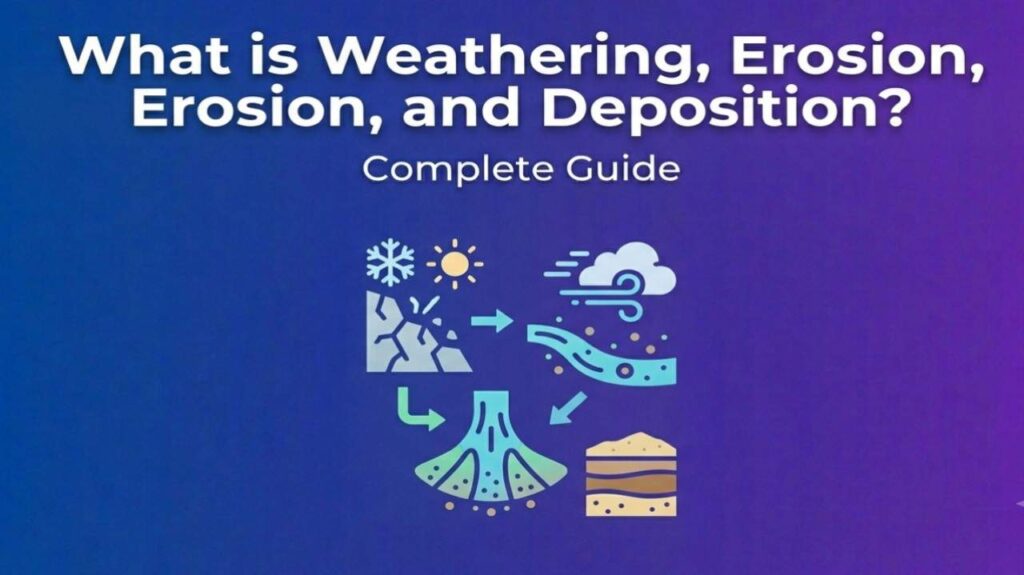
What Is Weathering, Erosion, and Deposition – Weathering, erosion, and deposition are the three main processes that break down, move, and rebuild Earth’s surface. Weathering breaks rocks into smaller pieces, erosion transports them, and deposition drops them in new locations.
Definitions
- Weathering: The process that breaks down rocks and minerals at or near Earth’s surface into smaller pieces. It happens in place without moving the material.
- Erosion: The removal and transportation of weathered material by agents like water, wind, ice, or gravity.
- Deposition: The dropping or settling of eroded sediments in a new place when the transporting agent loses energy.
These processes work together in a continuous cycle that shapes landscapes over time.
How They Work
Weathering occurs in two main ways:
- Physical (mechanical): Breaks rocks apart without changing their chemical makeup (e.g., freeze-thaw cycles, abrasion, plant roots).
- Chemical: Changes the rock’s minerals through reactions with water, acids, or oxygen (e.g., rusting of iron, dissolution by acidic rain).
Erosion moves the broken material. Flowing water, wind, glaciers, and gravity act as agents. Faster or stronger agents carry larger particles.
Deposition happens when the agent slows down. Heavier particles drop first. This builds new landforms like deltas, beaches, and sand dunes.
Examples
- Grand Canyon: Weathering weakens rock, the Colorado River erodes it away over millions of years.
- Mushroom rocks: Wind erodes the base of rocks more than the top.
- Deltas: Rivers deposit sediment at their mouths, creating fertile land (e.g., Mississippi River Delta).
- Beaches: Waves erode cliffs and deposit sand along shores.
Also Read-What is a Customization Service App
Weathering vs. Erosion vs. Deposition
- Weathering breaks things down in one location.
- Erosion moves the material away.
- Deposition builds up new features elsewhere.
They form a sequence: weathering prepares material, erosion moves it, and deposition places it. Without weathering, there would be little to erode. Without erosion, sediments would stay in place.
FAQs : What Is Weathering, Erosion, and Deposition
What is the main difference between weathering and erosion?
Weathering breaks rocks down in place. Erosion transports the broken pieces to another location.
How do weathering, erosion, and deposition shape the Earth?
They wear down mountains, carve valleys, and build plains, beaches, and deltas over long periods.
Can these processes happen quickly?
Most occur slowly over years or centuries, but events like floods or landslides can speed up erosion and deposition.
What are the main agents of erosion?
Water, wind, ice (glaciers), and gravity.
Do humans affect these processes?
Yes. Activities like farming, construction, and deforestation can accelerate weathering and erosion.