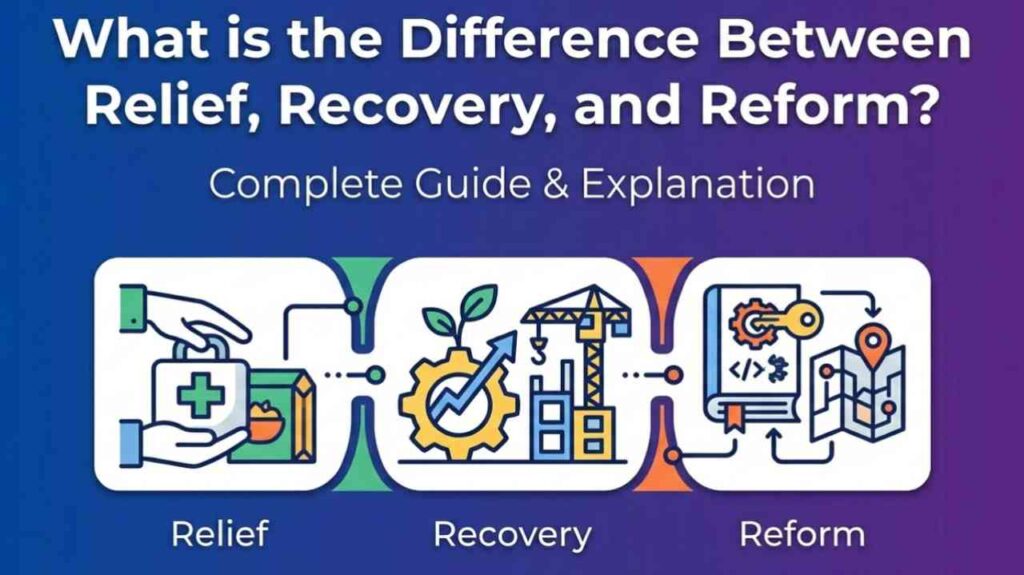
What is the Difference Between Relief, Recovery, and Reform – Relief, Recovery, and Reform are distinct strategies within the New Deal, each serving a different purpose in addressing the economic and social challenges of the 1930s.
Relief
- Immediate Aid: Direct support for unemployed and poor citizens.
- Examples: Federal Emergency Relief Administration (FERA), Civilian Conservation Corps (CCC).
- Goal: Provide short-term assistance to ease suffering.
Recovery
- Economic Stabilization: Programs designed to revive industry, agriculture, and employment.
- Examples: National Industrial Recovery Act (NIRA), Agricultural Adjustment Act (AAA).
- Goal: Restore the economy to normal functioning.
Reform
- Structural Change: Long-term policies to prevent future depressions.
- Examples: Social Security Act, Securities Exchange Act, Federal Deposit Insurance Corporation (FDIC).
- Goal: Create safeguards and regulations for lasting stability.
Also Read-What Is A Prepaid Sim Card
Comparison Table
| Category | Purpose | Examples | Timeframe |
|---|---|---|---|
| Relief | Immediate aid | FERA, CCC | Short-term |
| Recovery | Economic revival | NIRA, AAA | Medium-term |
| Reform | Long-term change | Social Security, FDIC | Permanent |
FAQs : What is the Difference Between Relief, Recovery, and Reform
Which came first—Relief, Recovery, or Reform?
Relief programs were implemented first to address urgent needs, followed by Recovery and then Reform.
Why were all three needed?
Relief helped people survive, Recovery rebuilt the economy, and Reform ensured future stability.
Are these concepts still used today?
Yes, governments often apply similar strategies during economic crises.
Did all programs succeed?
Not all, but many laid the foundation for modern U.S. economic and social policies.