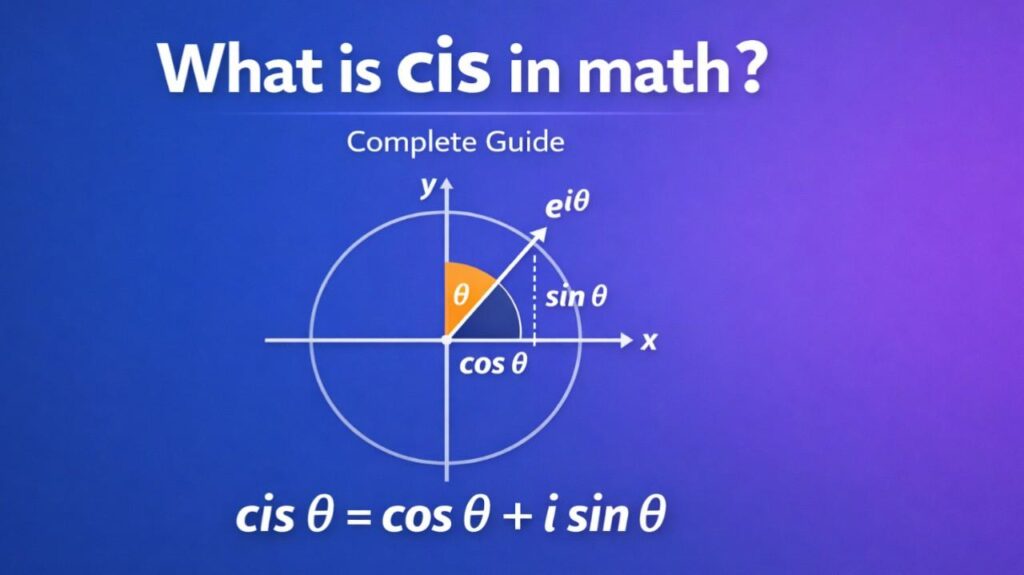
What is cis in math?- Cis in math is a shorthand notation for the trigonometric form of a complex number.
Cis stands for cos + i sin. It is defined as cis θ = cos θ + i sin θ, where θ is an angle in radians, cos is the cosine function, i is the imaginary unit, and sin is the sine function.
Also Read-What Is The Fastest Hoverboard
What is Cis in Math?
Cis provides a compact way to express complex numbers in polar form. Instead of writing r(cos θ + i sin θ), you can write r cis θ.
This notation comes from Euler’s formula, where cis θ = e^(iθ). It simplifies calculations involving powers and roots of complex numbers.
How It Works
A complex number z can be written in rectangular form (a + bi) or polar form.
- Magnitude r = √(a² + b²)
- Argument θ = atan2(b, a)
Then, z = r cis θ.
Example
The complex number 3 + 4i has magnitude 5 and angle ≈ 53.13° (or ≈ 0.927 radians).
It equals 5 cis 0.927 (in radians) or 5 cis 53.13°.
Also Read – What is f 3 9 1 1 9
Common Uses
- De Moivre’s Theorem: Raising to powers becomes easy. [r cis θ]^n = r^n cis (nθ)
- Finding nth roots of complex numbers.
- Multiplying and dividing complex numbers in polar form (multiply magnitudes, add angles).
- Trigonometry and electrical engineering applications.
Comparison with Related Terms
- Cis vs. Euler’s formula: Cis θ is exactly equal to e^(iθ). Euler’s form is more common in advanced math and calculus.
- Cis vs. full polar form: Cis is a shorter version of cos θ + i sin θ. Many high school textbooks use cis for simplicity.
FAQs
Q: What does cis stand for in math?
A: Cis stands for “cosine i sine” (cos θ + i sin θ).
Q: Is cis used in university-level math?
A: Less often. It appears mainly in high school precalculus. University courses prefer Euler’s exponential form.
Q: How do you convert from cis form back to rectangular?
A: Expand it: r cis θ = r cos θ + i r sin θ.
Q: Can you use degrees or radians with cis?
A: Yes, but specify the unit. Radians are standard in higher math.
Q: Is cis the same as polar form?
A: Cis is part of the polar/trigonometric form of complex numbers.