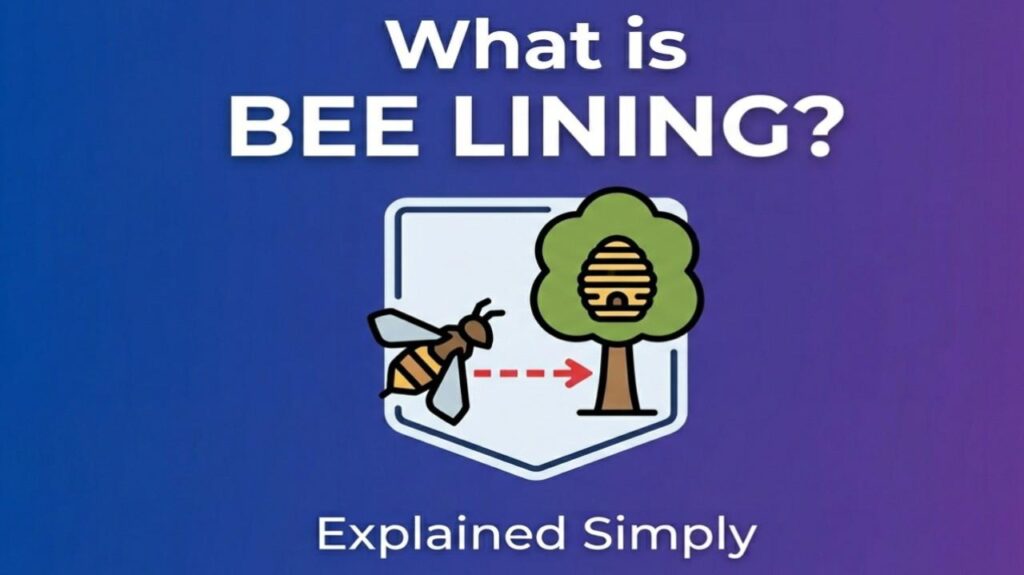
What Is Bee Lining ? – Bee lining (also called bee hunting or bee coursing) is the traditional practice of locating feral or wild honey bee colonies by capturing foraging bees, feeding them, and following their straight return flight path — known as a “beeline” — back to their nest in a tree or cavity.
How Bee Lining Works
Bees fly in a direct line back to their hive after loading up on food. Bee liners exploit this behavior:
- Capture bees at flowers or a bait station using a special two-compartment bee lining box.
- Feed them sugar syrup or honey on a piece of comb inside the box.
- Observe the direction they fly when released (the beeline).
- Mark bees with paint or powder to track individuals.
- Measure time of round trips to estimate distance.
- Move the box along the line in stages until the colony is found.
This process uses basic trigonometry and patient observation to triangulate the hive location.
Tools Needed
- Bee lining box (a small wooden box with sliding partitions and viewing windows)
- Sugar syrup or honey
- Old comb
- Paint or powder for marking bees
- Compass, binoculars, and notebook
Also Read-what is an sae project
Benefits and Uses
- Locates wild colonies for honey harvesting, swarm capture, or study.
- Helps beekeepers expand apiaries with local, adapted genetics.
- Serves as a rewarding outdoor skill and citizen science activity.
- Preserves traditional knowledge of honey hunting.
Bee Lining vs. Modern Beekeeping
Bee lining finds existing feral hives, while modern beekeeping manages domesticated colonies in man-made hives. Many use bee lining to catch wild swarms and start new managed hives. It requires no advanced equipment but demands patience and fieldcraft.
FAQs : What Is Bee Lining ?
Why is it called bee lining?
It refers to the straight “beeline” that loaded honey bees fly back to their colony.
Is bee lining legal?
Generally yes, but check local regulations on capturing wild bees or harvesting on public/private land.
Can beginners try bee lining?
Yes. Start in areas with known wild bees during late summer or fall when foraging is active.
Does bee lining harm the bees?
Done carefully, it causes minimal disturbance. Many practitioners aim to observe or sustainably harvest rather than destroy colonies.
What is the best time for bee lining?
Late summer and early fall when natural nectar flows decrease and bees readily take sugar syrup.