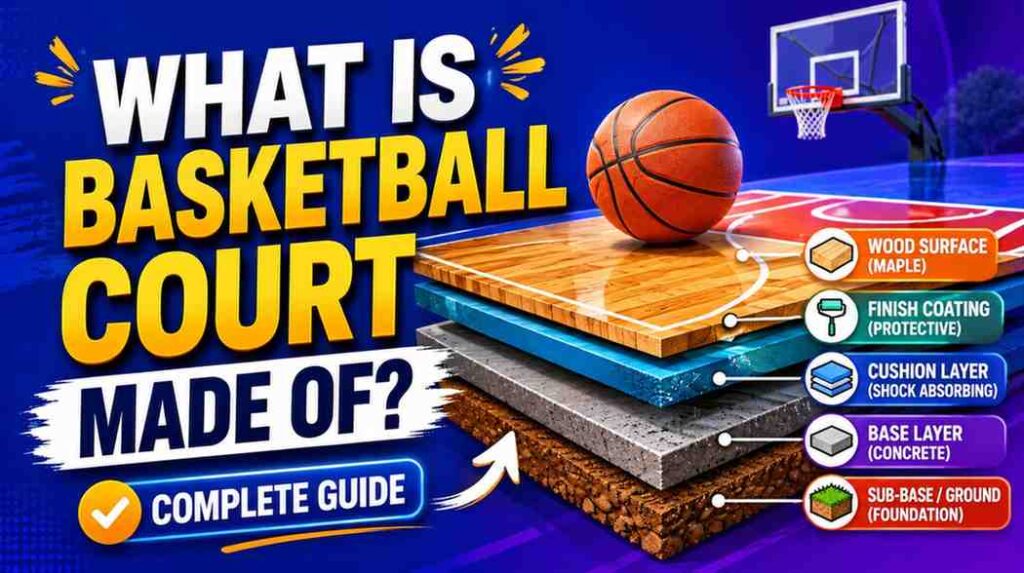
What is basketball court made of? – A basketball court is typically made of polished hardwood (usually maple) for indoor play, while outdoor courts are built with concrete, asphalt, or synthetic materials for durability against weather. The choice of material directly affects ball bounce, player safety, and maintenance needs.
What is Basketball Court Made Of?
Basketball court made of different materials depending on whether it is indoors or outdoors. Each surface is chosen for performance, safety, and longevity.
Basketball court made of hardwood, concrete, asphalt, or synthetic surfaces. Indoor courts almost always use polished maple wood for consistent ball bounce and traction. Outdoor courts rely on concrete or asphalt for durability, sometimes enhanced with synthetic coatings or modular tiles for better grip and weather resistance.
Also Read – What is hop up on airsoft
Types of Basketball Court Materials
1. Hardwood
- Standard for professional and collegiate indoor courts.
- Usually maple wood, kiln-dried and sealed for smoothness.
- Provides excellent ball response and shock absorption.
- Requires regular maintenance (sanding, refinishing).
2. Concrete
- Common for outdoor courts.
- Extremely durable but hard on joints.
- Low maintenance but less forgiving on falls.
3. Asphalt
- Slightly more flexible than concrete.
- Reduces impact stress compared to concrete.
- Can crack over time due to weather.
4. Synthetic Surfaces
- Includes polyurethane, vinyl, rubber, or modular tiles.
- Offers cushioning, weather resistance, and customization.
- Popular in multi-use gyms and modern outdoor facilities.
Benefits of Each Material
| Material | Best For | Pros | Cons |
|---|---|---|---|
| Hardwood | Indoor, professional play | Smooth bounce, traction, aesthetics | Expensive, high maintenance |
| Concrete | Outdoor, public courts | Durable, low cost | Hard on joints, less forgiving |
| Asphalt | Outdoor, recreational | Flexible, cheaper than hardwood | Weather damage, cracks |
| Synthetic | Indoor/outdoor multi-use | Cushioned, versatile, weather-resistant | Can be costly, less traditional |
FAQs
Q: Why is maple wood preferred for indoor courts?
A: Maple has a fine grain, hardness, and natural shock absorption, making it ideal for consistent ball bounce and player safety.
Q: Can outdoor courts use wood?
A: Rarely. Wood is not weather-resistant, so outdoor courts almost always use concrete, asphalt, or synthetic tiles.
Q: What’s the most budget-friendly option?
A: Concrete is the cheapest and most durable for outdoor use, though it sacrifices comfort compared to asphalt or synthetic surfaces