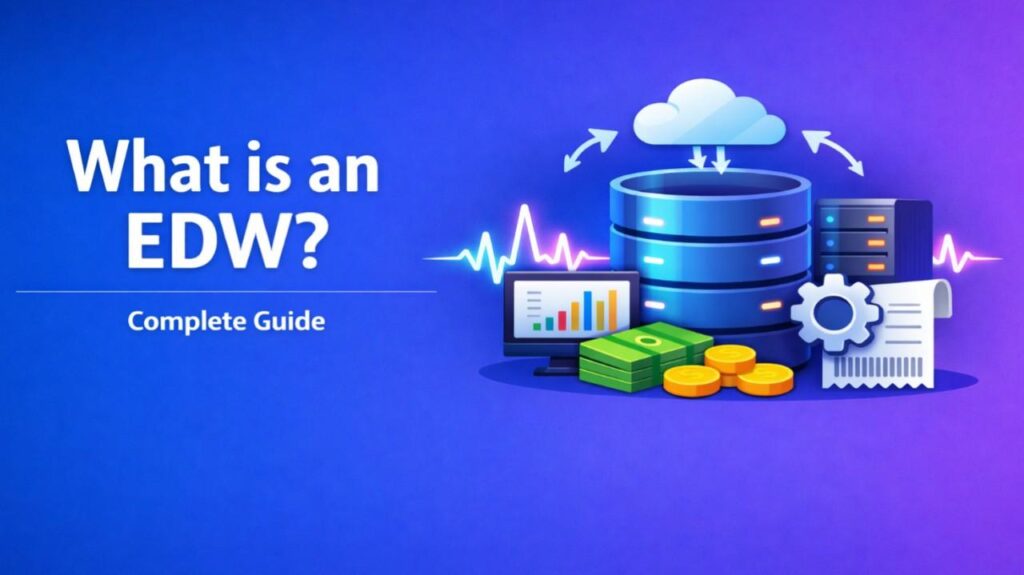
What is an EDW – EDW (Enterprise Data Warehouse) is a large-scale database that consolidates structured data from different operational systems—such as finance, sales, HR, and marketing—into one unified repository. It enables organizations to run advanced queries, generate reports, and perform analytics on historical and current data.
How an EDW Works
- Data integration: Collects information from multiple systems.
- ETL process: Extracts, transforms, and loads data into the warehouse.
- Centralized storage: Maintains consistent, cleaned, and structured data.
- Analytics-ready: Supports dashboards, predictive models, and reporting tools.
Types of EDW
- On-premise EDW – Hosted within company servers.
- Cloud EDW – Managed by providers like AWS Redshift, Google BigQuery, or Snowflake.
- Hybrid EDW – Combines on-premise and cloud storage for flexibility.
Benefits of an EDW
- Single source of truth: Eliminates data silos.
- Improved decision-making: Provides accurate insights.
- Scalability: Handles large volumes of data.
- Historical analysis: Tracks trends over time.
- Data consistency: Ensures uniform definitions across departments.
Also Read-What is the first step in the reassessment process
Examples of EDW Platforms
- Snowflake – Cloud-native, scalable warehouse.
- Amazon Redshift – Popular for big data analytics.
- Google BigQuery – Serverless, fast query execution.
- Microsoft Azure Synapse – Integrated with Microsoft ecosystem.
EDW vs. Database
| Aspect | EDW | Database |
|---|---|---|
| Purpose | Analytics & reporting | Transaction processing |
| Data | Historical + integrated | Current, operational |
| Scale | Enterprise-wide | Application-specific |
| Users | Analysts, executives | Developers, operations staff |
FAQs : What is an EDW
Is EDW the same as a data lake?
No. An EDW stores structured, cleaned data, while a data lake holds raw, unstructured data.
Who uses an EDW?
Business analysts, data scientists, and executives for reporting and insights.
Does every company need an EDW?
Not always. Small businesses may rely on simpler databases, but larger enterprises benefit from EDWs.
How is EDW different from BI tools?
EDW is the data storage layer, while BI tools (like Tableau or Power BI) visualize and analyze that data.