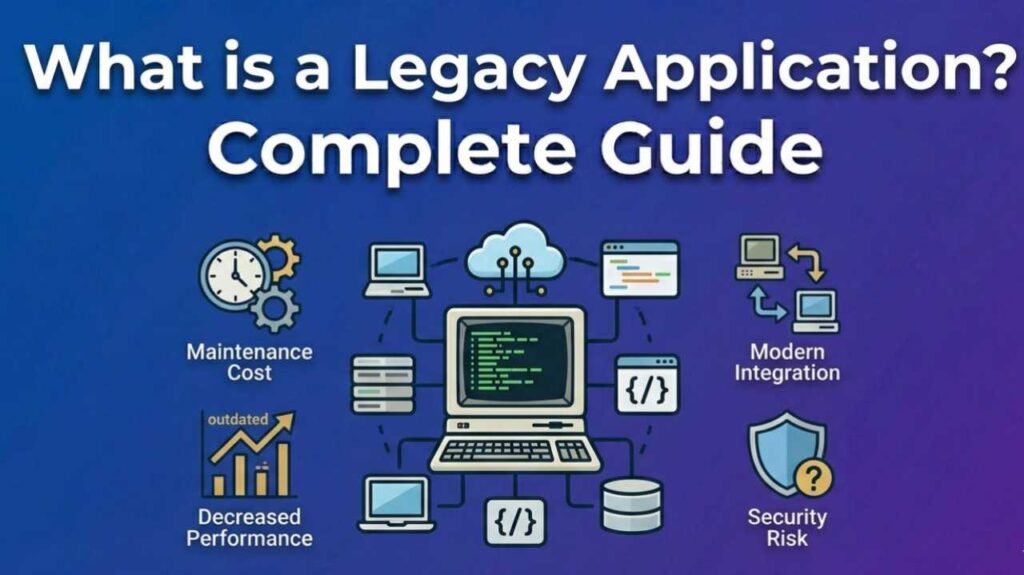
What is a legacy application refers to software that is built on outdated technologies but is still actively used by organizations. A legacy application often supports critical business functions, yet lacks modern security, integration, and scalability features. Companies keep them because they remain essential, even though they may be costly and risky to maintain.
How a Legacy Application Works
- Core role: Continues to run vital business processes such as finance, supply chain, or customer databases.
- Technology base: Built on older frameworks, operating systems, or hardware.
- Maintenance: Often patched or minimally updated but not fully modernized.
- Integration limits: Difficult to connect with modern cloud or API-driven platforms.
Types of Legacy Applications
- Outdated technology: Built on old programming languages or frameworks.
- End-of-life applications: No longer supported by vendors.
- Monolithic applications: Large, tightly coupled systems that are hard to scale or modify.
Benefits of Keeping Legacy Applications
- Business continuity: They still perform critical tasks reliably.
- Cost avoidance: Upgrading or replacing may be too expensive.
- Workflow dependency: Deeply embedded in daily operations.
Risks of Legacy Applications
- Security vulnerabilities: Lack of updates makes them easy targets.
- High maintenance costs: Require specialized skills and outdated hardware.
- Compliance issues: May not meet modern regulatory standards.
- Slow innovation: Prevents adoption of new digital tools.
Also Read-What is March Tempo
Examples
- Banking systems running on COBOL.
- Airline reservation platforms built decades ago.
- Healthcare record systems tied to outdated databases.
Comparison: Legacy Application vs Legacy System
| Legacy Application | Legacy System | |
|---|---|---|
| Refers to outdated software | Refers to entire technology environment | |
| Focus on program or app | Includes hardware, OS, databases, networks | |
| Example: old CRM software | Example: mainframe + apps + OS together |
FAQs : What is a Legacy Application?
Why do companies still use legacy applications?
Because they remain functional, are deeply integrated, or too costly to replace.
How can legacy apps be modernized?
Through rehosting, replatforming, refactoring, rebuilding, or replacing.
Are legacy applications always decades old?
Not necessarily. Even software 5–10 years old can be “legacy” if it no longer scales or integrates.
What industries rely heavily on legacy apps?
Banking, airlines, healthcare, and government.