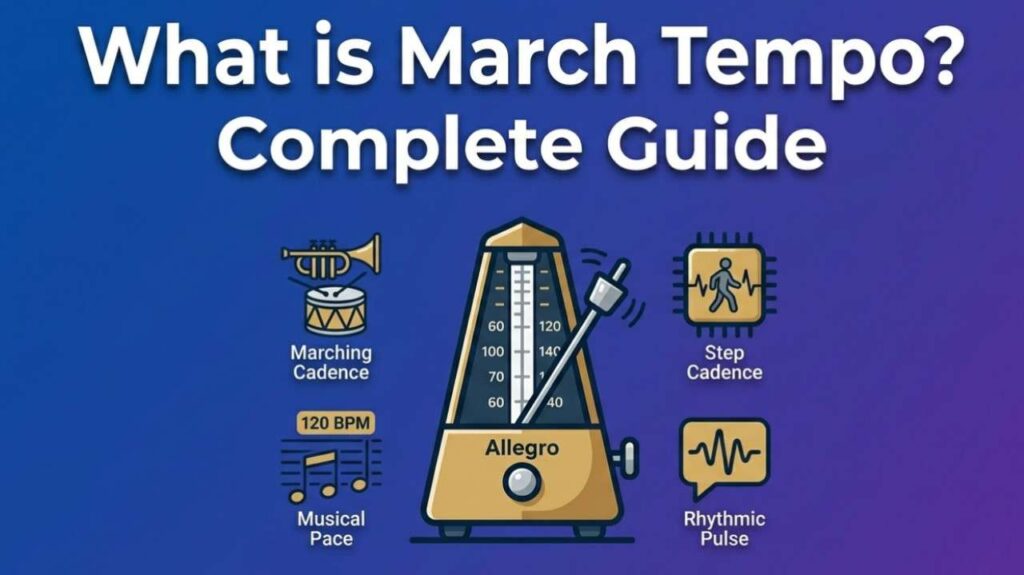
What is march tempo refers to the standard speed at which march music is played, typically around 120 beats per minute (BPM). This tempo matches the pace of soldiers walking in step, ensuring synchronization during military parades or processions. Funeral marches, however, often use a slower tempo of about 60 BPM.
How March Tempo Works
- Purpose: Designed to align with the rhythm of marching feet.
- Standard Tempo: 120 BPM, equating to 120 steps per minute.
- Funeral Marches: Slower, around 60 BPM, reflecting solemnity.
- Time Signatures: Commonly written in 2/4, 4/4, or 6/8.
Types of March Tempo
1. Quick march
- Around 120 BPM.
- Used in military parades and ceremonial events.
2. Slow march
- Around 60 BPM.
- Common in funerals or solemn occasions.
3. Double-time march
- Faster than 120 BPM.
- Used for rapid troop movement.
Benefits and Uses
- Synchronization: Keeps large groups moving in rhythm.
- Ceremonial impact: Sets the mood for parades, funerals, or celebrations.
- Musical tradition: Integral to compositions by composers like John Philip Sousa and Franz Schubert.
Also Read-What is a Chatbot?
Examples of March Tempo in Music
- Beethoven’s Eroica Symphony (funeral march section).
- Chopin’s Marche Funèbre (slow march).
- Sousa’s The Stars and Stripes Forever (quick march).
FAQs : What is March Tempo?
Why is march tempo usually 120 BPM?
It matches the natural pace of walking in step, ensuring uniformity.
Can marches be written in other tempos?
Yes, but 120 BPM and 60 BPM are the most common standards.
What instruments emphasize march tempo?
Percussion (especially drums) and brass drive the rhythm.
Is march tempo only for military music?
No, it’s also used in symphonies, parades, and ceremonial events.