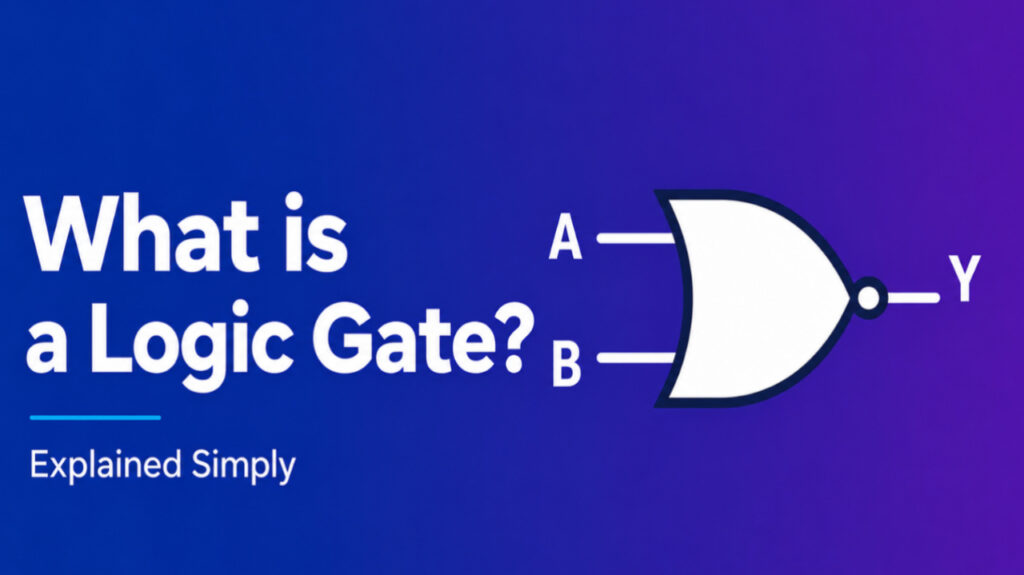
What Is A Logic Gate ? – A logic gate is a fundamental building block of digital circuits. It is an electronic device or circuit that performs a basic logical operation on one or more binary inputs (0 or 1) and produces a single binary output based on a specific rule, such as AND, OR, or NOT. Logic gates enable all modern computing and digital electronics.
What Is a Logic Gate?
A logic gate is a physical or virtual device that implements a Boolean function. It decides an output (true or false / 1 or 0) according to logical rules applied to its inputs. These simple gates combine to create complex processors, memory, and virtually every digital system.
How a Logic Gate Works
Logic gates operate using Boolean algebra, where inputs and outputs are binary:
- 0 represents false/low voltage (usually 0V).
- 1 represents true/high voltage (e.g., 3.3V or 5V).
Each gate type follows a fixed rule. For example, an AND gate outputs 1 only if all inputs are 1. Engineers represent these rules with truth tables that list every possible input combination and its output. Gates are built from transistors that switch electrical signals on or off.
- AND Gate: Output is 1 only if all inputs are 1.
- OR Gate: Output is 1 if at least one input is 1.
- NOT Gate (Inverter): Output is the opposite of the input (single input).
- NAND Gate: AND gate followed by NOT (output is 0 only if all inputs are 1).
- NOR Gate: OR gate followed by NOT.
- XOR Gate (Exclusive OR): Output is 1 if inputs are different.
- XNOR Gate: Output is 1 if inputs are the same.
NAND and NOR are called universal gates because you can build any other gate from them.
Uses and Benefits of Logic Gates
Logic gates form the foundation of:
- Microprocessors and CPUs
- Memory chips (RAM, ROM)
- Digital displays and calculators
- Control systems in appliances and cars
- Encryption hardware and communication devices
Benefits:
- Extremely fast switching (billions of operations per second).
- High reliability and low power consumption in modern designs.
- Scalability — millions or billions of gates fit on a single chip.
- Enables complex decision-making through combinations.
Also Read- What Is A Data Breach ?
Examples
- A simple security alarm might use an OR gate: Trigger if any sensor detects motion.
- An AND gate in a car: Allow engine start only if seatbelt is fastened and brake is pressed.
- Combinations of gates create adders, multiplexers, and full processors.
FAQs : What Is A Logic Gate ?
What are logic gates made of?
Primarily transistors (in CMOS technology today). Earlier designs used relays, vacuum tubes, or diodes.
How many inputs can a logic gate have?
Most basic gates have 2 inputs, but gates can have 3 or more. NOT has only 1.
What is the difference between positive and negative logic?
In positive logic, high voltage = 1. In negative logic, high voltage = 0. Most modern systems use positive logic.
Are logic gates only in hardware?
No. Software and programming languages simulate logic gates through Boolean operations (&&, ||, ! in code).
Why are NAND and NOR gates important?
They are universal — any other logic function can be constructed using only NAND or only NOR gates, simplifying chip manufacturing.