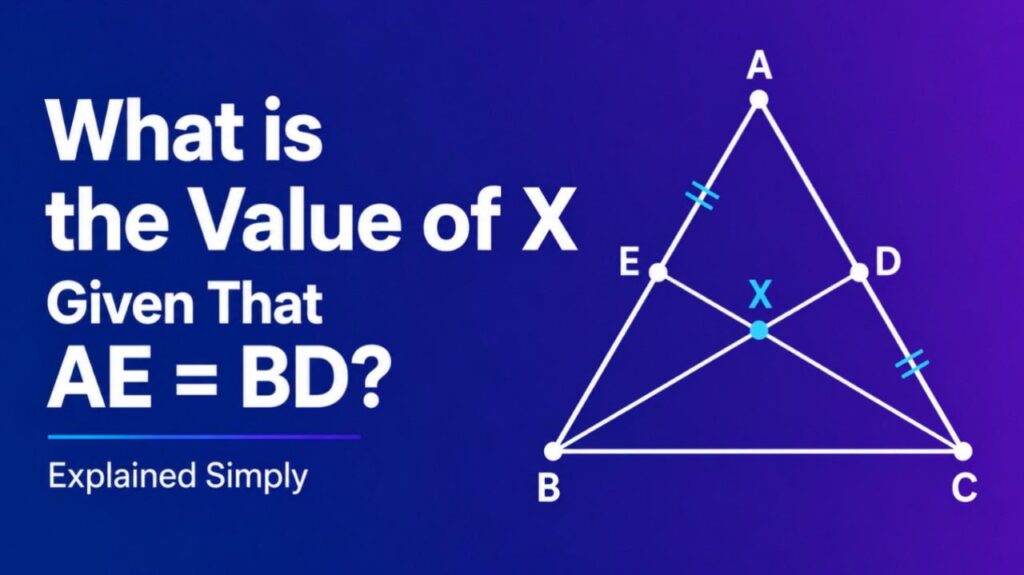
What is the Value of X Given That AE = BD – The value of x depends on the specific diagram and given measurements. When AE = BD in a geometry problem, x typically represents a missing length or angle found using properties of triangles, parallel lines, or similar figures.
Common Scenarios
In many textbook problems, AE and BD are segments in intersecting lines, triangles, or trapezoids. If AE = BD, you often apply:
- Triangle congruence (SSS, SAS)
- Similar triangles and proportion
- Vertical angles or alternate interior angles
How to Solve for X
- Identify the figure (usually two triangles or parallel lines)
- Note the given equality AE = BD
- Look for equal angles or other congruent sides
- Set up an equation using the given lengths
- Solve for x algebraically
Example: If triangles ABE and BDA share AE = BD and another side or angle, you may prove congruence and set corresponding sides equal.
Also Read-What is a Thru Lane
Tips for These Problems
- Draw and label the diagram clearly
- Mark equal segments and angles
- Check for vertical angles at intersection points
- Use the transitive property when needed
FAQs : What is the Value of X Given That AE = BD
What does AE = BD usually indicate?
It often signals isosceles triangles, congruent triangles, or parallelograms.
Can I assume x is a length?
Usually yes, but check if x represents an angle measure.
What if the diagram shows parallel lines?
Use properties of transversals and proportional segments.
Are these problems always about triangles?
Not always. They can involve quadrilaterals or circles too.