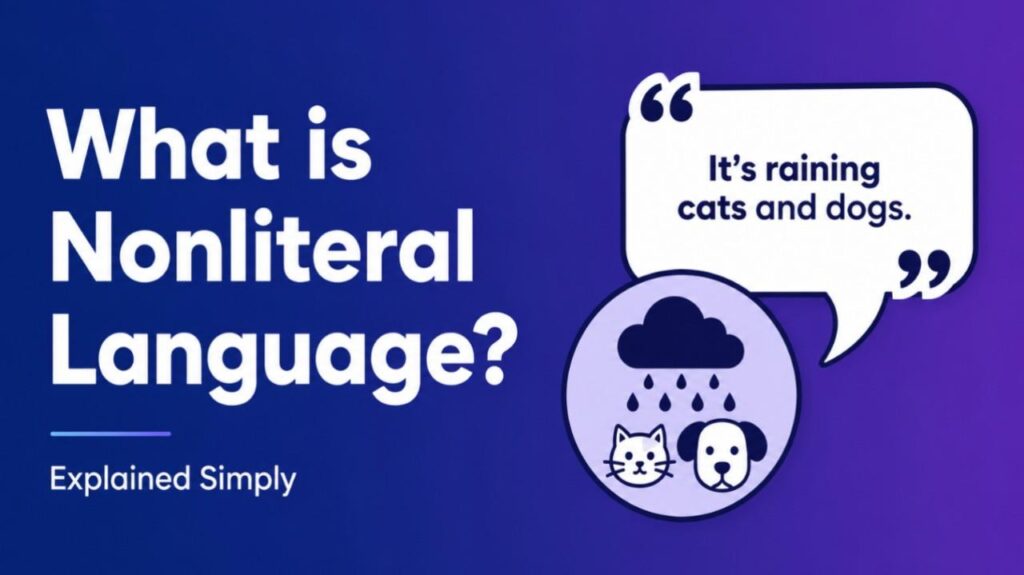
What is nonliteral language – Nonliteral language is language that uses words in a way that goes beyond their dictionary or literal meanings to convey a different or deeper idea, often for effect, imagery, or emphasis.
Nonliteral language (also called figurative language) means the words do not mean exactly what they say. It requires the listener or reader to interpret implied or creative meanings rather than taking the statement at face value.
Literal vs Nonliteral Language
- Literal language says exactly what it means. Example: “It is raining outside.”
- Nonliteral language suggests something else. Example: “It is raining cats and dogs” means it is raining heavily, not that animals are falling from the sky.
Common Types of Nonliteral Language
- Similes: Comparisons using “like” or “as.” Example: “She runs like the wind.”
- Metaphors: Direct comparisons without “like” or “as.” Example: “Time is a thief.”
- Idioms: Phrases with meanings different from the individual words. Example: “Break a leg” means good luck.
- Hyperbole: Exaggeration for emphasis. Example: “I’m so hungry I could eat a horse.”
- Personification: Giving human traits to non-human things. Example: “The wind whispered through the trees.”
Why Use Nonliteral Language?
Writers and speakers use it to:
- Create vivid images
- Add humor or emotion
- Express ideas more creatively
- Make language more engaging and memorable
It appears frequently in poetry, stories, everyday conversation, and advertising.
Also Read-What is a Lash Map
Examples in Context
- Literal: “He is very tall.”
- Nonliteral: “He is a giant among men.”
Understanding nonliteral language helps with reading comprehension, especially in literature and tests.
FAQs : What is nonliteral language
What is the difference between literal and nonliteral language?
Literal means exactly what the words say. Nonliteral uses words to suggest something different or deeper.
Why do people use nonliteral language?
It makes communication more interesting, emotional, and imaginative.
Are all idioms nonliteral language?
Yes. Idioms are a common type of nonliteral language
How can I improve at understanding nonliteral language?
Read widely, pay attention to context, and practice explaining what phrases really mean.