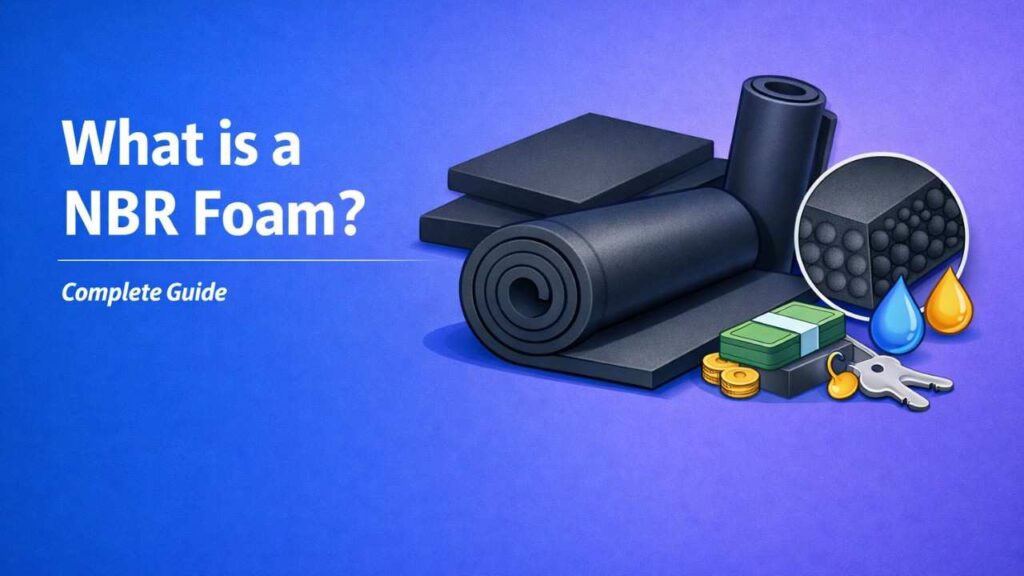
What is NBR Foam – NBR foam is a closed-cell material made from nitrile butadiene rubber (NBR), valued for its oil resistance, flexibility, and insulation properties. It is widely used in automotive, HVAC, industrial sealing, and cushioning applications because it withstands harsh environments while remaining lightweight and durable.
How NBR Foam Works
- Composition: Made from acrylonitrile and butadiene copolymers.
- Structure: Closed-cell design prevents water absorption and improves sealing.
- Performance: Offers resilience, compressibility, and recovery under stress.
- Resistance: Excellent against oils, fuels, and many solvents.
Types of NBR Foam
- Closed-cell NBR foam: Waterproof, ideal for sealing and insulation.
- Open-cell NBR foam: Softer, used for cushioning and vibration dampening.
- HNBR foam: Heat-resistant variant for high-temperature applications.
Benefits / Uses
- Insulation: Low thermal conductivity makes it effective in HVAC and refrigeration.
- Sealing & Gaskets: Prevents leaks in machinery due to chemical resistance.
- Vibration Dampening: Absorbs shock and reduces noise in automotive and industrial equipment.
- Durability: Lightweight yet long-lasting, reducing maintenance costs.
Also Read-What is a Jigger
Examples
- Automotive: Used in fuel system seals and vibration dampening pads.
- Construction: Thermal insulation in HVAC ducts.
- Electronics: Seals and cushioning for sensitive components.
- Consumer Goods: Exercise mats, protective padding, and packaging.
Comparison with Related Materials
| Material | Key Strength | Limitation |
|---|---|---|
| NBR Foam | Oil & solvent resistance | Moderate heat resistance |
| EPDM Foam | Weather & ozone resistance | Poor oil resistance |
| Neoprene Foam | Balanced durability | Less chemical resistance |
FAQs : What is NBR Foam
Is NBR foam waterproof?
Yes, closed-cell NBR foam is waterproof and ideal for sealing.
Can NBR foam handle high temperatures?
Standard NBR foam works up to ~100°C, while hydrogenated NBR (HNBR) can handle up to 150°C.
Is NBR foam safe for consumer products?
Yes, it is commonly used in exercise mats, gloves, and protective padding.
How does NBR foam compare to EPDM?
NBR is better for oil resistance, while EPDM is superior for outdoor weather resistance.