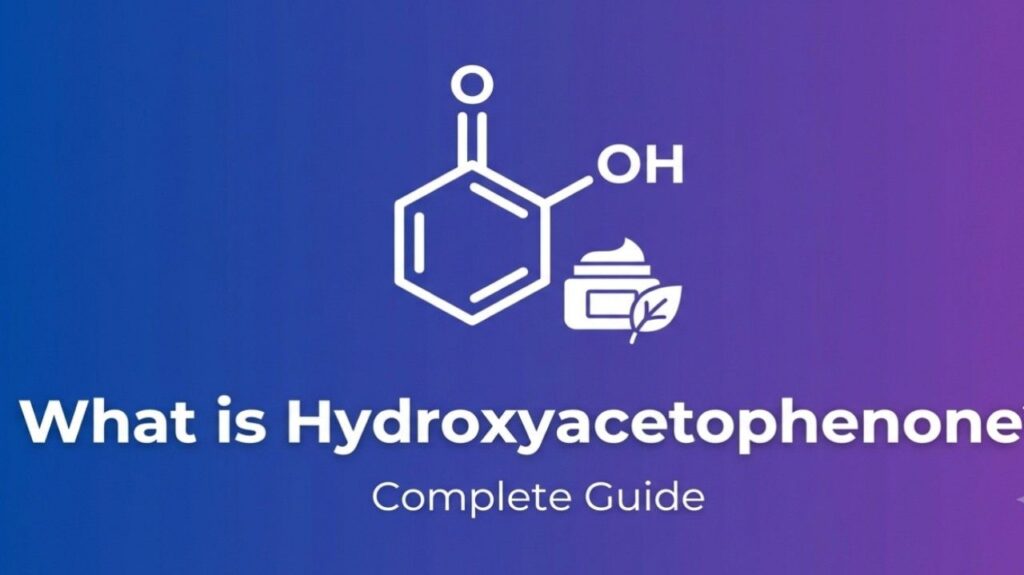
What is hydroxyacetophenone – Hydroxyacetophenone is a synthetic antioxidant and multifunctional ingredient commonly used in skincare and cosmetic products. It also serves as a preservative booster, soothing agent, and skin-conditioning humectant.
Hydroxyacetophenone (also known as 4′-hydroxyacetophenone, p-hydroxyacetophenone, or piceol) is an organic compound with the chemical formula C₈H₈O₂. It is a phenolic ketone that occurs naturally in small amounts in plants like Norwegian spruce needles, cloudberries, and others, though commercial versions are typically synthesized.
Chemical Properties
- Structure: It consists of an acetophenone backbone with a hydroxy group at the para (4′) position on the benzene ring.
- Appearance: White to beige crystalline powder.
- Solubility: Moderately water-soluble up to typical use levels (around 1%).
- Stability: Heat-stable and effective across a wide pH range in formulations.
Main Uses in Cosmetics and Skincare
Hydroxyacetophenone is valued for its versatility rather than as a primary active ingredient:
- Preservative Booster: Enhances the effectiveness of traditional preservatives (like phenoxyethanol), allowing formulators to use lower concentrations while maintaining antimicrobial protection. This reduces irritation risk for sensitive skin.
- Antioxidant: Neutralizes free radicals, helping stabilize formulas against oxidation and providing mild anti-aging support.
- Soothing Agent: Inhibits COX-2 enzyme activity on the skin’s surface, which can reduce signs of irritation and inflammation.
- Skin Conditioning: Acts as a humectant to help attract and retain moisture.
It is suitable for all skin types, including sensitive skin, and appears in creams, serums, lotions, and other leave-on products.
Also Read-What is the Zip Code for St. George Utah
Safety Profile
Hydroxyacetophenone is generally considered safe for cosmetic use at typical concentrations (often below 1%). The Cosmetic Ingredient Review (CIR) panel has concluded it is safe as used in present practices.
- EWG Rating: Low hazard (score of 1).
- Potential Concerns: Rare cases of skin sensitization or irritation, especially at higher concentrations. It may cause eye irritation in pure form. Avoid in very high concentrations or if you have known sensitivity.
- It is GRAS-listed for use as a flavoring agent in food.
FAQs – What is hydroxyacetophenone
Is hydroxyacetophenone natural?
It occurs naturally in trace amounts in some plants, but the form used in cosmetics is usually synthetic for purity and consistency.
Does hydroxyacetophenone replace preservatives?
No. It boosts existing preservatives, enabling milder, more skin-friendly preservation systems rather than fully replacing them.
Is it the same as other acetophenones?
No. The 4′-hydroxy (para) version is the one used in skincare. Other isomers (like 2′-hydroxy) have different properties and applications.
Can it cause allergies?
It has low allergenic potential, but as with any ingredient, patch testing is wise for those with very reactive skin.
What products contain it?
Look for it in modern “clean” or sensitive-skin formulas from brands focusing on gentle preservation.