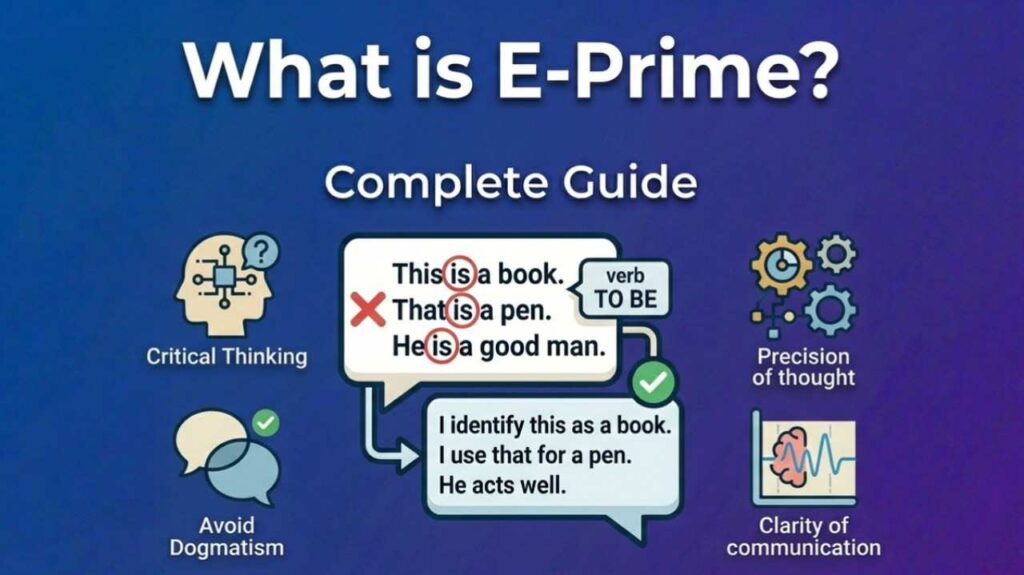
What is E-Prime refers to a modified form of English that eliminates all uses of the verb to be (is, are, was, were, etc.). E-Prime is a linguistic approach created by D. David Bourland Jr. in 1965 to encourage clearer, less dogmatic communication by replacing “to be” with more descriptive verbs and phrases.
How E-Prime Works
- Restriction: Writers avoid all forms of to be.
- Replacement: Use alternative verbs or constructions (e.g., “The cat is furry” → “The cat feels furry”).
- Goal: Reduce ambiguity, assumptions, and absolute statements.
- Application: Used in writing, therapy, and communication training.
Benefits of E-Prime
- Clarity: Forces writers to describe experiences instead of labeling.
- Reduced bias: Avoids “deity mode” speech where opinions sound like facts.
- Improved communication: Encourages subjective, context-aware language.
- Critical thinking: Helps writers and speakers examine assumptions.
Also Read-What is an Equivalent Fraction for 6/10
Examples of E-Prime
| Colloquial English | E-Prime Version |
|---|---|
| The electron is a particle. | The electron functions as a particle. |
| Your dress is awful. | I don’t like your dress. |
| Sarah is a dental hygienist. | Sarah cleans teeth from nine to five. |
| There is a cat. | A cat exists. |
Comparison: E-Prime vs Standard English
| E-Prime | Standard English |
|---|---|
| Excludes to be verbs | Includes all verb forms |
| Focuses on subjective description | Allows identity and predication |
| Reduces dogmatic statements | Can reinforce rigid labels |
| Example: “I don’t like your dress” | Example: “Your dress is awful” |
FAQs : What is E-Prime
Who invented E-Prime?
D. David Bourland Jr., building on Alfred Korzybski’s general semantics.
Why avoid the verb “to be”?
It often creates absolute, judgmental, or misleading statements.
Is E-Prime practical for everyday use?
It works well in writing and therapy, but most people find it challenging to use in casual speech.
Does E-Prime change meaning?
It shifts focus from identity to description, making statements more precise.