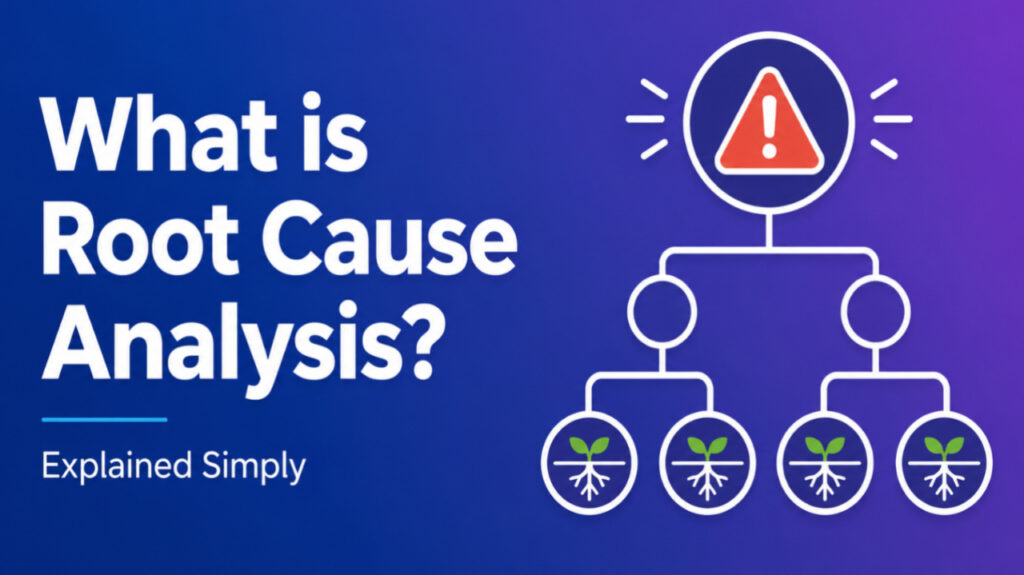
What Is A Root Cause Analysis ? – A root cause analysis is a problem-solving method used to identify the underlying reason an issue occurred, rather than just addressing its symptoms. It helps organizations prevent recurring problems by finding and fixing the true source of failure.
What is a Root Cause Analysis?
A root cause analysis (RCA) is a structured approach to uncover the fundamental reason behind a problem. Instead of treating surface-level effects, RCA digs deeper to reveal what triggered the issue, ensuring long-term solutions rather than temporary fixes.
How Root Cause Analysis Works
- Identify the Problem: Define what went wrong.
- Collect Data: Gather evidence, logs, or reports.
- Analyze Causes: Use tools like the 5 Whys or Fishbone Diagram to trace the issue back to its origin.
- Find the Root Cause: Determine the single most critical factor.
- Implement Solutions: Apply corrective actions to prevent recurrence.
- Monitor Results: Verify that the fix is effective over time.
Common Methods of Root Cause Analysis
- 5 Whys: Ask “why” repeatedly until the true cause is revealed.
- Fishbone Diagram (Ishikawa): Visual tool that categorizes potential causes.
- Failure Mode and Effects Analysis (FMEA): Evaluates possible points of failure in a process.
- Pareto Analysis: Focuses on the most frequent causes using the 80/20 rule.
Benefits / Uses
- Prevention: Stops problems from recurring.
- Efficiency: Saves time and resources by fixing the real issue.
- Quality Improvement: Enhances processes and customer satisfaction.
- Risk Management: Identifies vulnerabilities before they escalate.
Also Read-what is an rss feed
Examples
- Manufacturing: RCA reveals that machine downtime was caused by poor maintenance scheduling, not operator error.
- Healthcare: Investigating a medication error uncovers unclear labeling as the root cause.
- IT Systems: RCA shows that recurring outages stemmed from outdated server configurations.
Root Cause Analysis vs. Troubleshooting
| Aspect | Root Cause Analysis | Troubleshooting |
|---|---|---|
| Goal | Find underlying cause | Fix immediate problem |
| Approach | Systematic, long-term | Quick, short-term |
| Outcome | Prevent recurrence | Restore functionality |
| Tools | 5 Whys, Fishbone, FMEA | Logs, error messages, patches |
FAQs : What Is A Root Cause Analysis ?
Is root cause analysis only for big problems?
No. RCA can be applied to both minor and major issues to prevent future failures.
How long does RCA take?
It depends on complexity—some issues are solved in hours, others may take weeks.
Who should perform RCA?
Cross-functional teams often collaborate, ensuring multiple perspectives.
Can RCA guarantee no future problems?
It reduces risk significantly, but continuous monitoring is still necessary.