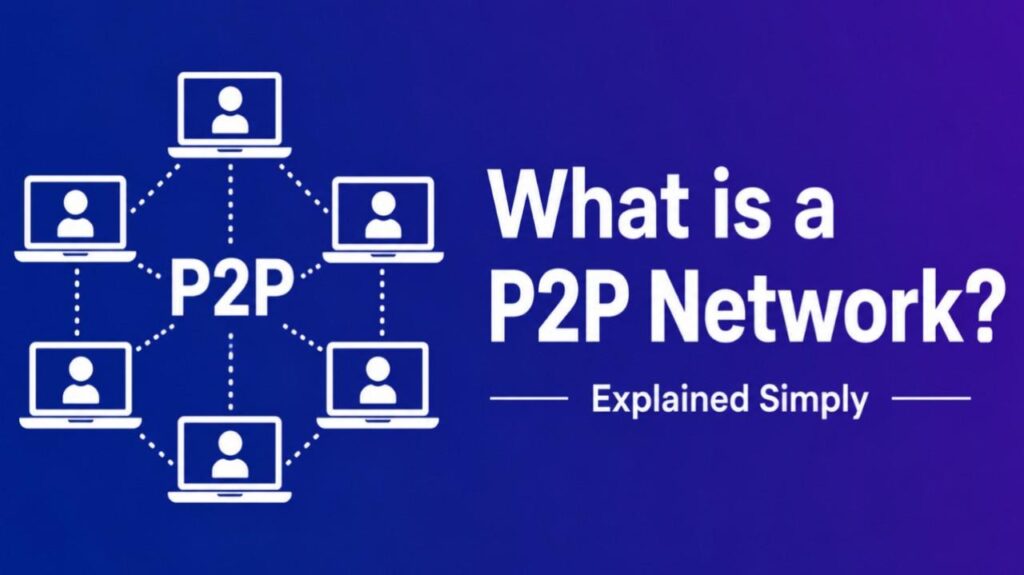
What Is A P2p Network ? – A P2P network (peer-to-peer network) is a decentralized network architecture where connected devices, called peers, directly share resources such as files, bandwidth, or processing power without relying on a central server. Each peer acts as both a client and a server.
How a P2P Network Works
- Connection — Peers discover each other using protocols, trackers, or distributed hash tables (DHT).
- Resource Sharing — When a peer requests data, it downloads pieces from multiple other peers simultaneously.
- Contribution — The requesting peer also uploads pieces it already has, distributing the load across the network.
- Decentralized Operation — No single point controls the network, making it resilient to failures.
This model contrasts with traditional client-server setups where one central server handles all requests.
Types of P2P Networks
- Unstructured — Peers connect randomly (e.g., early file-sharing systems). Simple but can be inefficient for searches.
- Structured — Use organized systems like DHT for faster resource location (e.g., BitTorrent).
- Hybrid — Combine P2P with some central elements for better coordination while keeping core sharing decentralized.
Benefits of P2P Networks
- Scalability — Performance often improves as more users join, since they contribute resources.
- Resilience — No single point of failure; the network continues if some peers go offline.
- Cost Efficiency — Reduces need for expensive central servers and bandwidth.
- Speed — Files download from multiple sources at once.
- Censorship Resistance — Harder to shut down than centralized systems.
Also Read-What Is A Cache Miss ?
Real-World Examples
- BitTorrent — Popular for sharing large files like movies, software, and games.
- Blockchain Networks — Bitcoin and many cryptocurrencies use P2P for transaction validation and distribution.
- Home Networks — Small setups where computers share printers or files directly.
- Streaming — Some video or live-streaming platforms use P2P to reduce server load.
P2P Network vs Client-Server (Common Comparison)
P2P Network: Decentralized, peers act as both clients and servers, highly scalable, resilient. Client-Server: Centralized, dedicated servers manage resources, easier to secure and control but creates bottlenecks and higher costs.
P2P excels at large-scale resource sharing, while client-server suits controlled environments like business intranets.
FAQs : What Is A P2p Network ?
Is P2P safe to use?
It depends. Legitimate uses are fine, but file-sharing networks can expose you to malware or legal risks if downloading copyrighted material. Use reputable software and antivirus.
What is the main advantage of a P2P network?
Scalability and fault tolerance — the more users, the stronger and faster the network becomes.
Is BitTorrent the only P2P network?
No. P2P technology powers many applications, including blockchain, some messaging apps, and distributed computing projects.
Do P2P networks use more bandwidth?
They distribute bandwidth across users, which is often more efficient than overloading a single server.
Can businesses use P2P networks?
Yes, for internal file sharing, collaboration, or content distribution, though many prefer hybrid or client-server for security reasons.