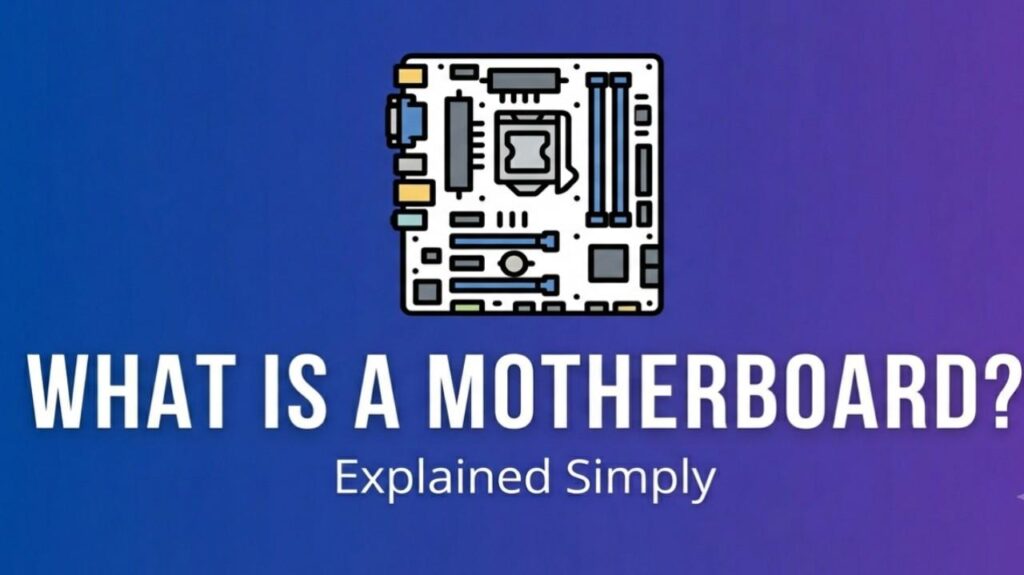
What Is a Motherboard? – A motherboard (also called a mainboard or logic board) is the largest circuit board inside a PC. It houses key sockets, slots, ports, and chips that bring all the other parts together and let them work together efficiently.
How a Motherboard Works
The motherboard acts as a communication highway:
- CPU Socket: Holds the processor and connects it to everything else.
- Chipset: Manages data flow between the CPU, memory, storage, and peripherals.
- RAM Slots: Connect memory modules for fast data access.
- Expansion Slots: PCIe slots for graphics cards, sound cards, or other add-ons.
- Storage Connectors: SATA, M.2, or NVMe slots for SSDs and HDDs.
- Power Connectors: Supply electricity from the power supply unit (PSU) to all components.
- I/O Ports: USB, HDMI, Ethernet, audio jacks on the rear panel.
It also contains the BIOS or UEFI firmware, which initializes hardware when you power on the computer.
Types of Motherboards
Motherboards come in different form factors (sizes and layouts):
- ATX: Standard full-size for most desktop PCs. Offers good expansion options.
- Micro-ATX: Smaller than ATX with fewer expansion slots. Fits smaller cases.
- Mini-ITX: Compact size for small form factor (SFF) builds. Limited expansion.
- E-ATX: Larger than ATX for high-end workstations with more features.
Laptops use proprietary, integrated motherboards that are not easily upgradeable.
Key Features and Benefits
- Connectivity: Links all components for seamless data transfer.
- Expandability: Allows upgrades like adding more RAM, better GPU, or storage.
- Stability: Quality motherboards include voltage regulation (VRM) for reliable performance, especially during overclocking.
- Features: Built-in Wi-Fi, Bluetooth, RGB headers, multiple USB ports, and advanced audio.
A good motherboard improves system performance, longevity, and future-proofing.
Also Read-what is machine learning used for
Popular Examples
- Gaming-oriented: ASUS ROG Strix or MSI MPG series.
- Budget-friendly: Gigabyte or ASRock boards.
- Workstation: Intel or AMD high-end models with strong VRMs.
FAQs : What Is A Motherboard ?
Do motherboards affect gaming performance?
Indirectly. They ensure stable power delivery and fast data paths, especially for high-end CPUs and GPUs. A poor motherboard can limit overclocking or cause instability.
Can I upgrade just the motherboard?
Yes, but you often need to match CPU socket (e.g., Intel LGA 1700 or AMD AM5) and may need new RAM or cooler.
What is the difference between Intel and AMD motherboards?
They use different chipsets and CPU sockets. You must choose one that matches your processor brand and generation.
How long does a motherboard last?
Typically 5–10 years or more with proper care. Failures are less common than with other components.
Is motherboard size important?
Yes. It must fit your PC case. Larger boards offer more features but require bigger cases.