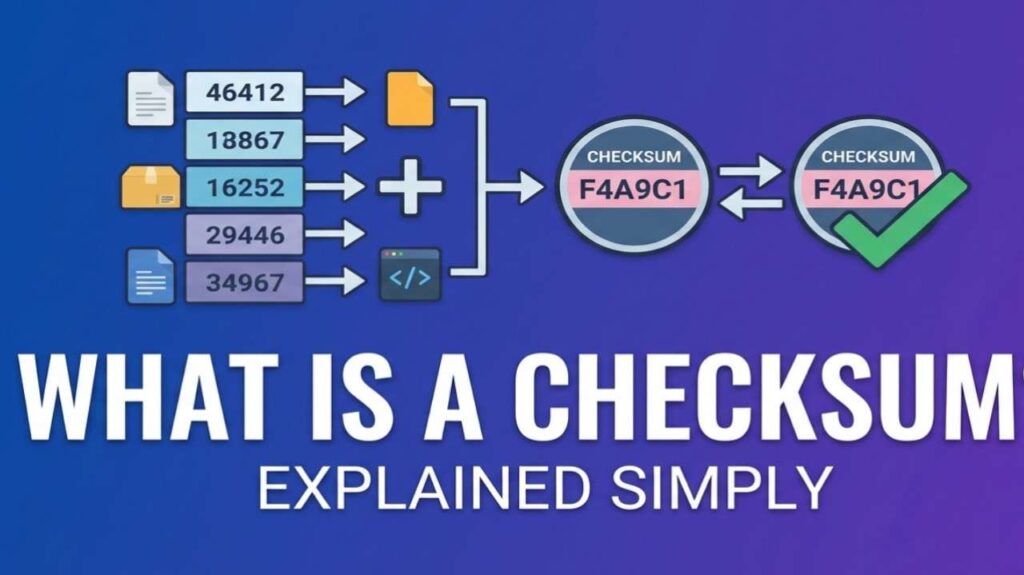
What is a Checksum – A checksum is a short value or string of characters calculated from a block of data. It detects errors, corruption, or changes that may occur during transmission, storage, or copying of files and data.
How a Checksum Works
Software or hardware runs a mathematical algorithm on the original data to produce the checksum. The same algorithm is later run on the received or stored data.
If the newly calculated checksum matches the original one, the data is likely intact. If it does not match, the data has been altered or corrupted, and you should discard or re-download it.
Checksums are fast to compute and effective for catching accidental errors, though they are not cryptographically secure against intentional tampering.
Common Types of Checksums
- Parity Check — Simple even/odd bit checking, used in basic error detection.
- Cyclic Redundancy Check (CRC) — Widely used in networks, storage devices, and file formats.
- MD5 — Produces a 128-bit hash, common for file verification.
- SHA-256 — Stronger and more secure, often used for important downloads and blockchain.
Benefits and Uses
- Ensures data integrity during file downloads.
- Verifies that software updates or firmware have not been corrupted.
- Detects transmission errors in networks and storage systems.
- Helps confirm identical copies of files across different systems.
Also Read-What Is An Rss Feed ?
Real-World Examples
- When you download a Linux ISO, the website provides an MD5 or SHA checksum. You run a tool to verify the downloaded file matches it.
- ZIP files and disk images often include built-in checksums.
- Network protocols like TCP use checksums to ensure packets arrive correctly.
Checksum vs Hash (Common Comparison)
A checksum focuses on detecting accidental errors and is usually simpler and faster. A cryptographic hash (like SHA-256) serves similar purposes but also provides strong security against deliberate changes and collisions.
Many modern checksums are actually cryptographic hashes.
FAQs : What is a Checksum
How do I check a checksum?
Use built-in tools like md5sum (Linux/macOS), CertUtil (Windows), or online verifiers. Compare the result with the provided checksum.
Can a checksum prove a file is safe?
It proves the file matches the original. It does not guarantee the original was malware-free
What happens if checksums don’t match?
The file is corrupted or incomplete. Re-download it or check for transfer errors.
Are checksums 100% reliable?
They catch most accidental errors but very strong ones (like CRC32 or SHA) are extremely reliable for everyday use.
Where are checksums commonly used?
Software downloads, blockchain, hard drives, network communications, and backup systems.