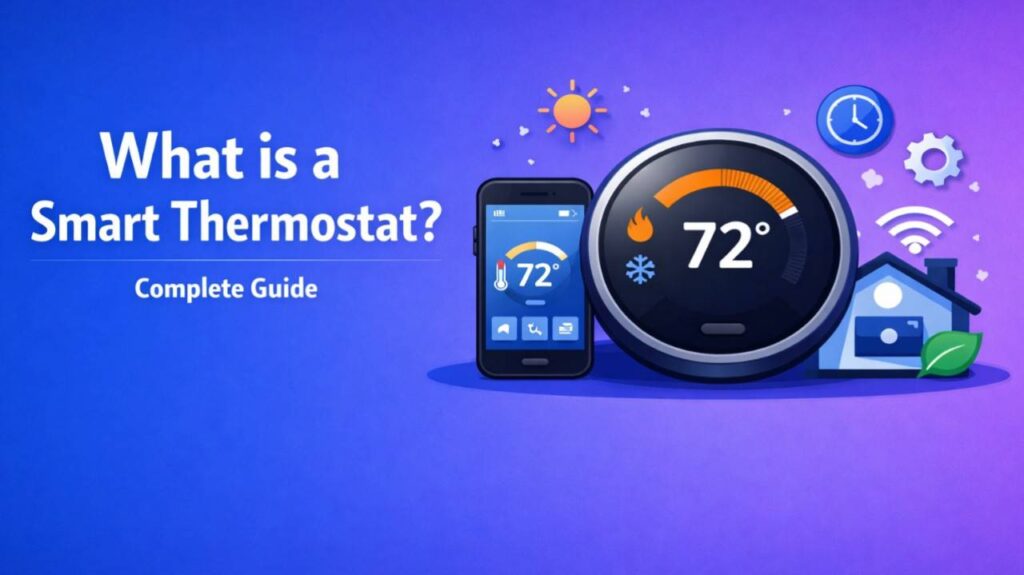
What Is a Smart Thermostat? – A smart thermostat is an advanced, internet-connected thermostat that controls your home’s heating and cooling more intelligently than traditional models. It learns your preferences, senses when you’re home or away, and lets you adjust settings from anywhere using a phone, tablet, or voice assistant.
How a Smart Thermostat Works
Smart thermostats connect to your home Wi-Fi and communicate with your HVAC system. Here’s the basic process:
- Sensors and Data Collection: Built-in or add-on sensors measure temperature, humidity, occupancy (via motion), and sometimes room-specific conditions.
- Automation and Learning: Many models learn your daily routines over time and create schedules. Features like geofencing use your phone’s location to adjust temperatures when you leave or approach home.
- Remote Control and Integration: Control via mobile apps. They integrate with smart home ecosystems (e.g., Alexa, Google Home) and can use weather forecasts to preemptively adjust settings.
- Energy Optimization: They automatically switch to energy-saving modes when the house is empty or at night.
Types of Smart Thermostats
- Learning Thermostats: Automatically adapt to your habits (e.g., Google Nest).
- Geofencing-Enabled: Adjust based on your phone’s location.
- Sensor-Based: Use additional room sensors for multi-zone comfort (e.g., Ecobee).
- Basic Wi-Fi Models: Focus on remote control and scheduling without advanced AI.
Most are compatible with standard HVAC systems, but check compatibility before buying.
Also Read-what is a pantry moth
Benefits of a Smart Thermostat
- Energy Savings: ENERGY STAR-rated models can save an average of 8% on heating and cooling bills by reducing unnecessary operation.
- Convenience: Change temperatures remotely or via voice commands — no more coming home to a hot or cold house.
- Improved Comfort: Even temperatures across rooms with sensors; automatic adjustments for sleep or away modes.
- Insights and Reports: Apps show energy usage patterns and tips to save more.
- Smart Home Integration: Works with lights, security, and other devices for a connected home.
Smart Thermostat vs. Traditional Thermostat
Traditional (non-programmable or basic programmable) thermostats require manual adjustments or cumbersome button programming. Many people never fully use their programmable features.
Smart thermostats make automation effortless with apps, learning algorithms, and remote access. They actively save more energy by detecting occupancy and adapting dynamically, while providing better usability and features traditional models lack.
Popular Examples
- Google Nest Learning Thermostat: Famous for its self-learning and sleek design.
- Ecobee SmartThermostat: Includes room sensors for whole-home comfort and strong voice control.
- Other options from Honeywell, Emerson, and Trane offer various price points and features.
FAQs : What Is A Smart Thermostat ?
How much does a smart thermostat cost?
Entry-level models start around $100–150, while premium learning models range from $200–300, plus possible installation fees.
Do smart thermostats require professional installation?
Many are DIY-friendly if you’re comfortable with basic wiring. Professional installation is recommended for complex systems or if unsure.
Will a smart thermostat work with my existing HVAC?
Most are compatible with standard systems, but verify compatibility using the manufacturer’s tool or consult an HVAC technician.
How much can I save with a smart thermostat?
Average savings are around 8–10% on energy bills, though results vary by usage, climate, and home efficiency.
Are smart thermostats secure?
Reputable brands use encryption and regular updates. Use strong passwords and keep firmware updated for best security.