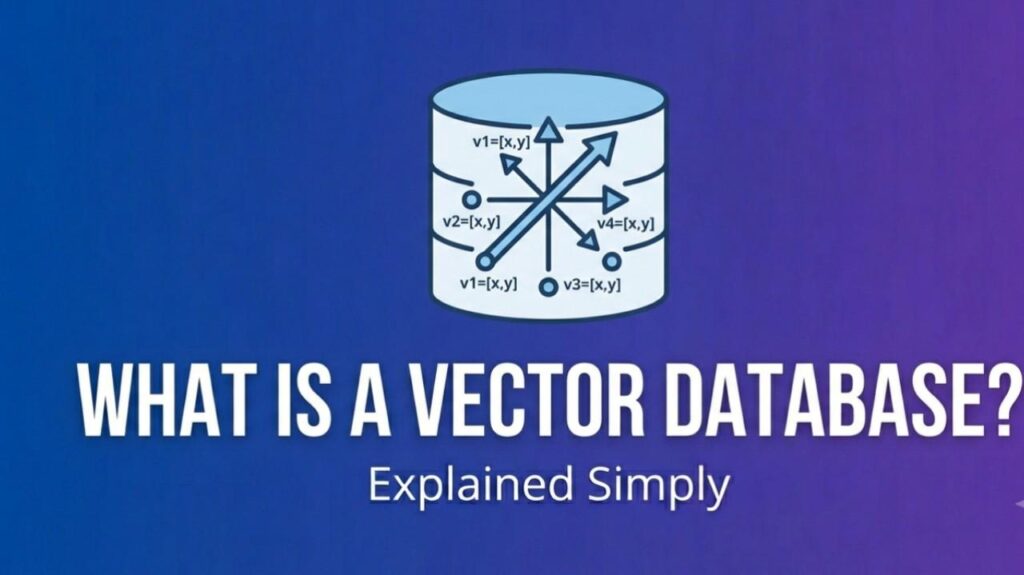
What is a Vector Database? – A vector database is a modern data storage system built to handle embeddings (vector representations) generated by machine learning models. Instead of traditional keyword or relational queries, it uses mathematical distance measures (like cosine similarity or Euclidean distance) to find the closest matches between vectors.
How a Vector Database Works
- Data Conversion: AI models convert raw data (text, images, etc.) into vectors.
- Storage: These vectors are stored in the database.
- Indexing: Specialized algorithms (e.g., HNSW, IVF) organize vectors for fast retrieval.
- Querying: When a user searches, their query is converted into a vector and compared against stored vectors.
- Results: The database returns items most similar to the query vector.
Benefits / Uses
- Semantic Search: Finds results based on meaning, not exact keywords.
- Recommendation Systems: Suggests products, movies, or music based on similarity.
- AI Applications: Powers chatbots, image recognition, and voice assistants.
- Fraud Detection: Identifies unusual patterns in financial transactions.
- Healthcare: Matches patient data with similar medical cases.
Also Read-what is a motherboard
Examples of Vector Databases
- Pinecone
- Weaviate
- Milvus
- FAISS (Facebook AI Similarity Search)
Vector Database vs. Traditional Database
| Aspect | Vector Database | Traditional Database |
|---|---|---|
| Data Type | High-dimensional vectors | Structured rows/columns |
| Query Method | Similarity search (distance metrics) | Exact match or relational queries |
| Use Case | AI, semantic search, recommendations | Transactional systems, record keeping |
| Examples | Pinecone, Milvus, Weaviate | MySQL, PostgreSQL, MongoDB |
FAQs : What Is A Vector Database ?
Why do we need vector databases?
Traditional databases aren’t optimized for similarity search across millions of vectors, making vector databases essential for AI-driven applications.
Can vector databases replace SQL databases?
No. They complement SQL/NoSQL databases by handling unstructured data and similarity queries.
How big can vectors be?
Vectors often range from 128 to 1,024 dimensions, depending on the AI model used.
Are vector databases only for AI?
While most common in AI, they’re also useful in cybersecurity, finance, and healthcare.