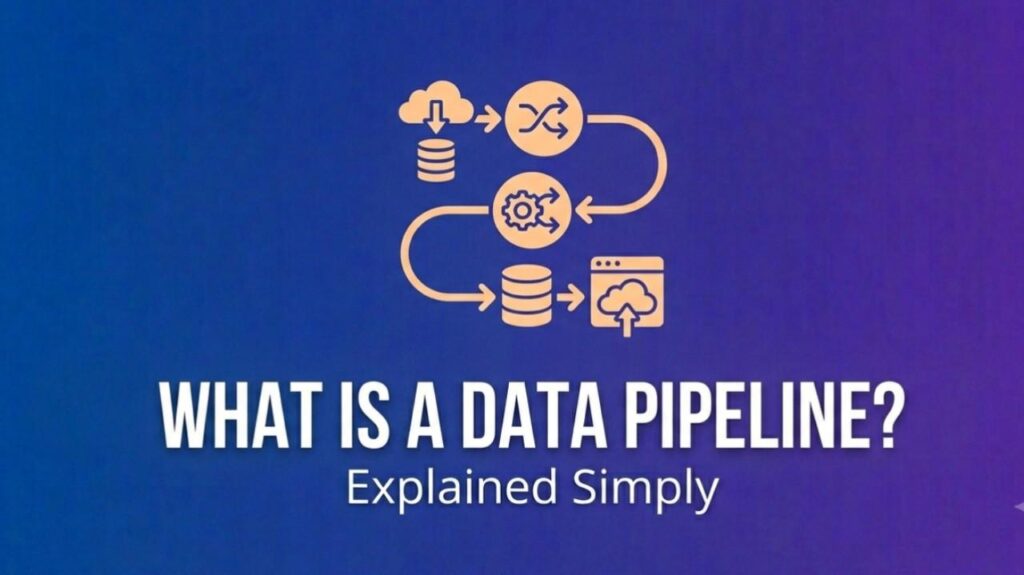
What is a Data Pipeline? – A data pipeline is the backbone of modern data management. It connects multiple systems, enabling organizations to collect, clean, transform, and deliver data efficiently. This automation reduces manual work and ensures data is reliable and ready for decision-making.
How a Data Pipeline Works
- Data Ingestion: Collects data from sources such as APIs, databases, or sensors.
- Processing: Cleans, filters, and transforms data into usable formats.
- Storage: Loads data into destinations like warehouses, lakes, or cloud platforms.
- Consumption: Analysts, applications, or machine learning models use the prepared data.
Types of Data Pipelines
- Batch Pipeline: Processes large volumes of data at scheduled intervals.
- Streaming Pipeline: Handles real-time data flows, ideal for IoT or financial transactions.
- ETL Pipeline: Extracts, transforms, and loads data into a target system.
- ELT Pipeline: Extracts and loads data first, then transforms it within the destination system.
Benefits / Uses
- Automation: Reduces manual data handling.
- Scalability: Handles growing volumes of data efficiently.
- Accuracy: Ensures consistent, clean data for analysis.
- Real-Time Insights: Enables instant decision-making with streaming pipelines.
- Integration: Connects diverse systems seamlessly.
Also Read-what is a heat dome
Examples
- An e-commerce company uses a pipeline to move sales data into a warehouse for daily reporting.
- A bank streams transaction data through a pipeline to detect fraud in real time.
- A healthcare provider processes patient records via a pipeline for predictive analytics.
Data Pipeline vs. Workflow
| Aspect | Data Pipeline | Workflow |
|---|---|---|
| Purpose | Moves and transforms data | Automates tasks or processes |
| Focus | Data flow between systems | Task execution and coordination |
| Example | ETL pipeline for analytics | Workflow for HR approvals |
FAQs : What Is A Data Pipeline ?
Is a data pipeline the same as ETL?
ETL is a type of data pipeline focused on extracting, transforming, and loading data. Pipelines can also handle streaming and other processes.
Do small businesses need data pipelines?
Yes. Even simple pipelines help automate reporting and reduce errors.
Can data pipelines handle unstructured data?
Yes. Modern pipelines process text, images, and logs alongside structured data.
What tools are used for data pipelines?
Popular tools include Apache Kafka, Apache Airflow, AWS Glue, and Google Dataflow.