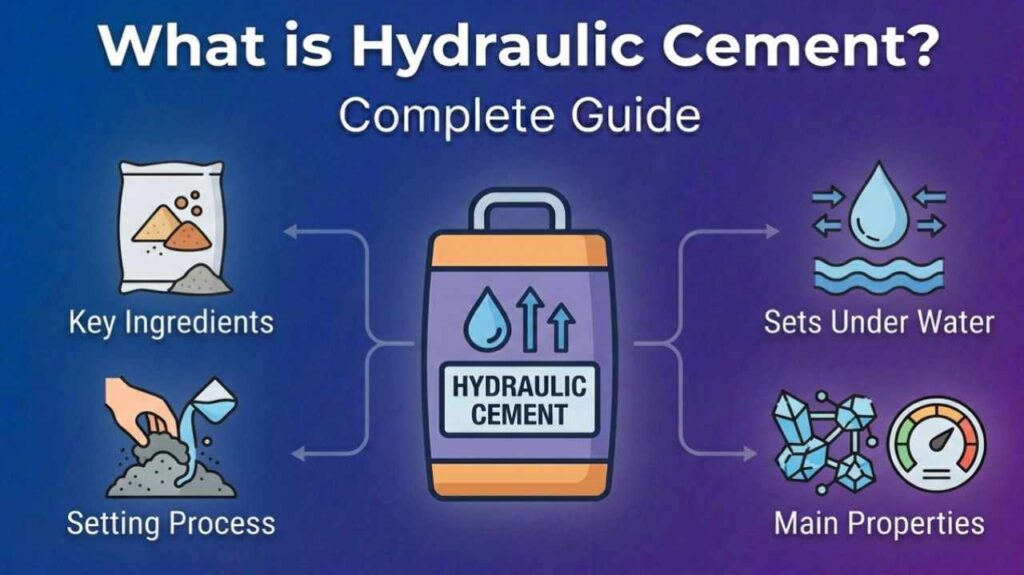
What is in Hydraulic Cement – Hydraulic cement contains compounds such as calcium silicates (alite and belite), tricalcium aluminate, and tetracalcium aluminoferrite, often blended with gypsum. These ingredients react with water to form a hardened mass, allowing the cement to set quickly and even underwater.
Key Ingredients in Hydraulic Cement
- Alite (3CaO·SiO₂)
- Provides early strength.
- Reacts quickly with water.
- Belite (2CaO·SiO₂)
- Contributes to long-term strength.
- Slower hydration compared to alite.
- Tricalcium aluminate (3CaO·Al₂O₃)
- Speeds up setting time.
- Requires gypsum to control rapid reaction.
- Brownmillerite (4CaO·Al₂O₃·Fe₂O₃)
- Adds strength and helps in liquid phase formation during production.
- Gypsum (CaSO₄·2H₂O)
- Controls setting time.
- Prevents flash setting.
- Additives (fly ash, slag, silica fume)
- Improve durability.
- Reduce environmental impact.
How Hydraulic Cement Works
- Hydration reaction: When mixed with water, calcium silicates and aluminates react to form hardened compounds.
- Quick setting: Begins to harden within minutes, making it ideal for emergency repairs.
- Water resistance: Unlike non-hydraulic cement, it sets and hardens even underwater.
Also Read-What Is A Cold Wallet
Benefits of Hydraulic Cement
- Fast setting: Useful for urgent repairs.
- Non-shrink: Maintains volume after curing.
- Durable in wet conditions: Ideal for dams, tunnels, and foundations.
- High compressive strength: Suitable for heavy-duty applications.
Examples of Use
- Repairing cracks in concrete walls and floors.
- Sealing leaks in basements or foundations.
- Construction of bridges, dams, and tunnels.
- Marine structures exposed to constant water contact.
FAQs : What is in Hydraulic Cement
Is hydraulic cement the same as Portland cement?
Portland cement is a type of hydraulic cement, but hydraulic cement also includes other blends designed for specific uses.
Can hydraulic cement be used underwater?
Yes, it sets and hardens even when submerged.
How fast does hydraulic cement set?
Typically within 3–5 minutes, depending on the blend.
Does hydraulic cement expand?
It does not shrink and may slightly expand, helping seal cracks tightly.