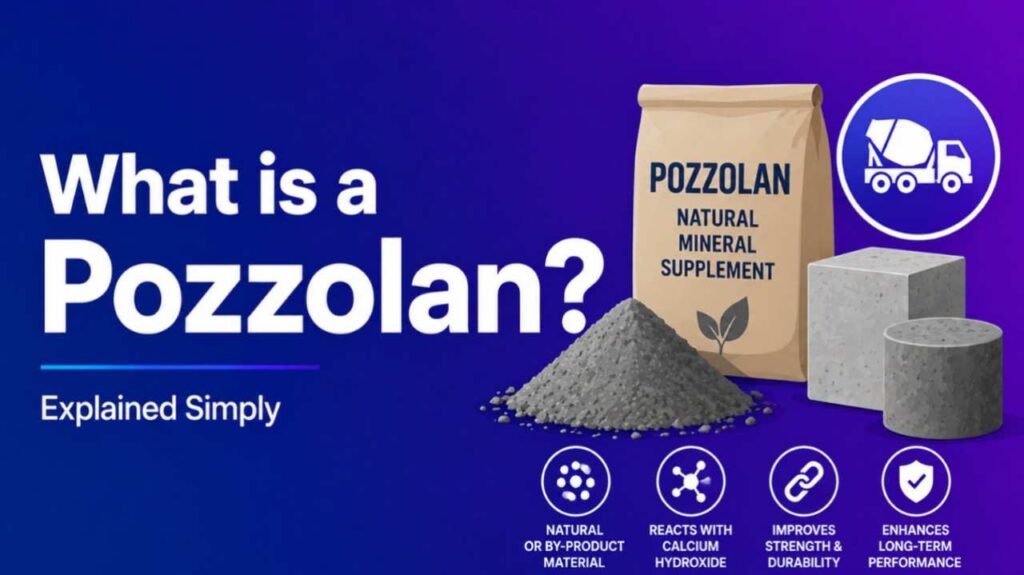
What is a Pozzolan – A pozzolan is a siliceous or aluminous material that has little or no cementing ability on its own but, when finely ground and mixed with water and calcium hydroxide, reacts to form compounds with cement-like properties. Natural examples include volcanic ash, while artificial pozzolans include fly ash and silica fume.
How Pozzolans Work
- Chemical Reaction: Pozzolans react with calcium hydroxide (a byproduct of cement hydration) in the presence of water.
- Result: This reaction forms stable compounds that strengthen concrete and reduce porosity.
- Benefit: Concrete becomes more durable, less permeable, and resistant to sulfate attack.
Also Read-What is bandwidth
Types of Pozzolans
| Type | Examples | Notes |
|---|---|---|
| Natural Pozzolans | Volcanic ash, pumice, tuff, diatomaceous earth | Used since Roman times; Pantheon concrete is a famous example |
| Artificial Pozzolans | Fly ash, silica fume, calcined clay, blast furnace slag | Byproducts of industry; widely used in modern concrete |
| Organic Pozzolans | Rice husk ash, sugarcane bagasse ash | Agricultural waste materials with pozzolanic properties |
Benefits of Using Pozzolans
- Improved durability: Reduces concrete permeability.
- Eco-friendly: Recycles industrial and agricultural byproducts.
- Cost-effective: Reduces cement usage.
- Long-lasting structures: Roman aqueducts and the Pantheon still stand due to pozzolan-based concrete.
FAQs : What is a Pozzolan
Why is volcanic ash considered a pozzolan?
It is rich in silica and alumina, which react with lime and water to form cementitious compounds.
What is the difference between pozzolan and Portland cement?
Portland cement generates lime internally during hydration, while pozzolans need external lime to react.
Can pozzolans replace cement completely?
No, they are supplementary materials. They enhance cement but cannot fully replace it.
Are pozzolans environmentally friendly?
Yes, especially artificial pozzolans like fly ash, which recycle industrial waste.