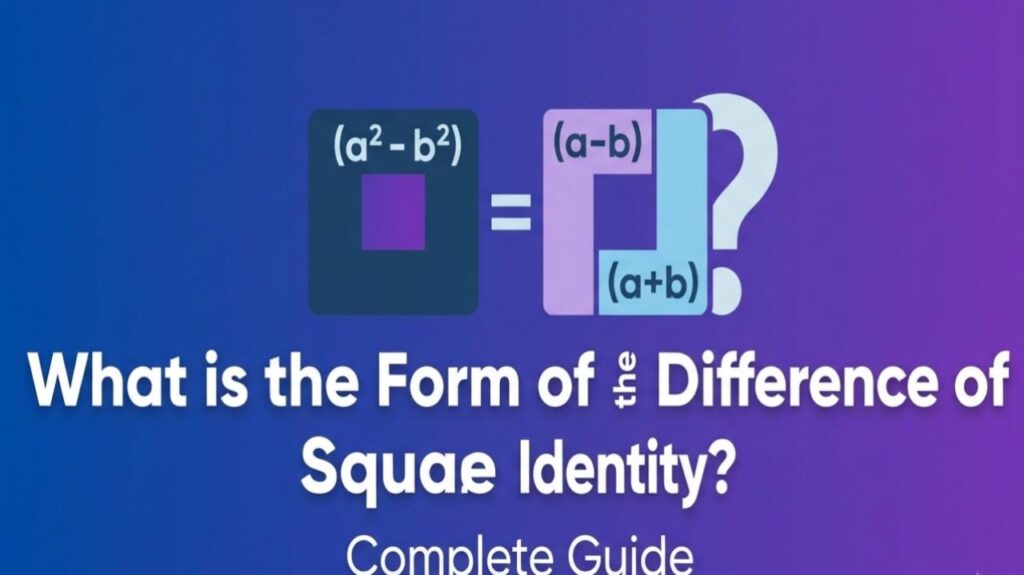
What is the Form of the Difference of Squares Identity
**The form of the difference of squares identity is:
(a2−b2)=(a−b)(a+b)
It shows that the difference between two squared terms can be factored into the product of their sum and difference.**
Featured Snippet
What is the form of the difference of squares identity? The difference of squares identity is written as:
(a2−b2)=(a−b)(a+b)
This algebraic formula expresses the subtraction of two squared numbers as the product of their sum and difference.
How It Works
- Start with two squared terms: a2 and b2.
- Subtract them: a2−b2.
- Factorization: Rewrite as (a−b)(a+b).
- Verification: Expanding (a−b)(a+b) gives a2−b2.
Benefits of the Identity
- Simplifies expressions: Quickly reduces complex algebraic forms.
- Speeds up calculations: Useful in mental math and shortcuts.
- Foundation for higher math: Appears in factoring polynomials, solving equations, and number theory.
Also Read-What is a Promposal
Examples
- x2−9=(x−3)(x+3)
- 25y2−16=(5y−4)(5y+4)
- m2−n2=(m−n)(m+n)
FAQs : What is the Form of the Difference of Squares Identity
Can the difference of squares identity be used with negative numbers?
Yes, as long as the terms are squares, the identity applies.
Is there a “sum of squares” identity?
No simple factorization exists for a2+b2 over real numbers.
Why is this identity important?
It is a fundamental factoring tool in algebra, used in solving equations and simplifying expressions.
Does it apply to higher powers?
Variations exist, but the classic identity is specific to squares.