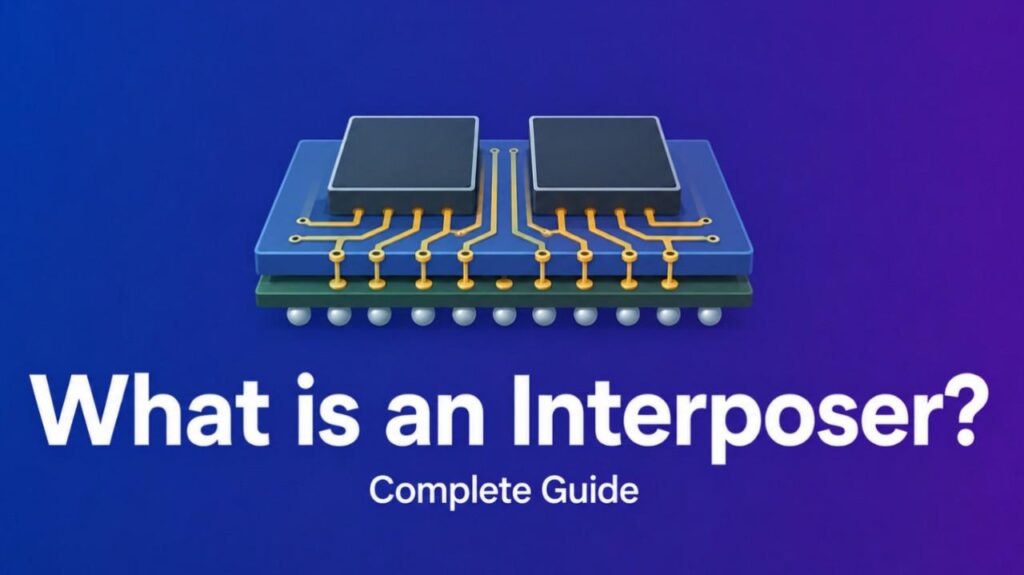
What is an Interposer – An interposer is an intermediate substrate or layer used in electronics to connect one component to another, typically between a semiconductor chip and a circuit board. It acts as a bridge, enabling high-density connections, improved performance, and integration of different technologies.
How an Interposer Works
- Placement: Positioned between the chip (like a CPU or GPU) and the package or PCB.
- Connections: Provides fine-pitch wiring that standard circuit boards cannot achieve.
- Integration: Enables multiple chips (logic, memory, sensors) to be combined in one package.
- Performance: Reduces signal loss and improves bandwidth.
Types of Interposers
- Silicon interposer: Offers high density and precision, often used in 2.5D packaging.
- Glass interposer: Provides low cost and good electrical properties.
- Organic interposer: Made from polymers, cheaper but less precise.
Also Read-What is a Street Address Number
Benefits / Uses
- High bandwidth: Supports faster communication between chips.
- Miniaturization: Allows compact designs in smartphones and GPUs.
- Heterogeneous integration: Combines different chip types (logic + memory).
- Improved reliability: Reduces stress on solder joints and connections.
Examples
- High-end GPUs use silicon interposers to connect memory (HBM) directly to the processor.
- Smartphones integrate multiple chips using organic interposers for compact designs.
- Data centers rely on interposers for advanced server processors with high bandwidth memory.
Comparison: Interposer vs PCB
| Interposer | PCB (Printed Circuit Board) |
|---|---|
| Thin intermediate layer | Full board for mounting components |
| Fine-pitch, high-density connections | Larger, less dense wiring |
| Used in advanced packaging | Used in general electronics |
| Enables chip-to-chip integration | Connects chips to external devices |
FAQs : What is an Interposer
Is an interposer the same as a PCB?
No, an interposer is a thin intermediate layer, while a PCB is a full board for mounting components.
Why are interposers important in 2.5D packaging?
They allow multiple chips to be placed side by side and connected with high bandwidth.
What materials are used for interposers?
Silicon, glass, and organic polymers.
Where are interposers commonly used?
In GPUs, CPUs, smartphones, and high-performance computing systems.