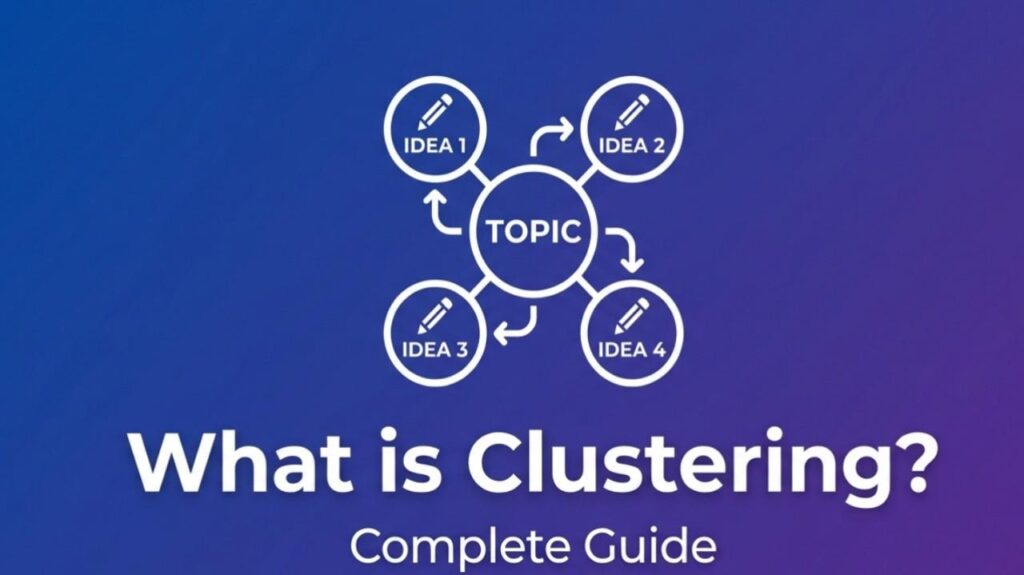
What is Clustering in Writing – Clustering in writing is a pre-writing technique that helps you generate and organize ideas visually by creating a diagram of related concepts around a central topic. It’s also known as mind mapping or idea mapping.
Clustering starts with a main idea in the center and branches out with connected words, phrases, and sub-ideas, forming a web-like structure. This method reveals relationships between thoughts quickly and sparks new connections without the pressure of linear structure.
How Clustering Works
The process is straightforward and flexible:
- Write your main topic or central idea in the middle of a blank page and circle it.
- Brainstorm related ideas, words, or phrases. Write them around the center and circle each one.
- Draw lines connecting these ideas back to the center or to each other to show relationships.
- Continue branching out: For each new idea, add supporting details, examples, or further associations.
- Review the clusters. Identify strong groups of connected ideas that can form sections of your writing.
You can do this on paper, a whiteboard, or with digital tools like mind-mapping software.
Benefits of Clustering in Writing
- Generates ideas freely: It bypasses writer’s block by encouraging quick, non-judgmental associations.
- Shows relationships: You see how ideas connect, which helps with organization and logical flow.
- Visual and engaging: Especially useful for visual learners who struggle with traditional lists or outlines.
- Flexible: Works for essays, stories, reports, or any creative project. It can help at the beginning or when stuck midway.
- Leads naturally to structure: Strong clusters become natural paragraphs or sections.
Also Read-What is Taiwan currency called
Clustering Example
Central Topic: Benefits of Exercise
- Branch 1: Physical Health
- Stronger muscles
- Better heart health
- Weight management
- Branch 2: Mental Health
- Reduces stress
- Improves mood (endorphins)
- Better sleep
- Branch 3: Daily Life
- More energy
- Social opportunities (team sports)
- Long-term habits
From this cluster, you could easily develop an essay with clear sections on physical, mental, and lifestyle benefits.
Clustering vs. Other Pre-Writing Techniques
Clustering vs. Brainstorming: Brainstorming often means making a simple list. Clustering is a visual form of brainstorming that emphasizes connections.
Clustering vs. Outlining: Outlining is linear and structured (Roman numerals, bullet points). Clustering is nonlinear and exploratory — perfect before you create a formal outline.
Clustering vs. Freewriting: Freewriting involves nonstop writing in sentences. Clustering focuses on keywords and visual links.
Many writers combine them: Cluster first to generate ideas, then outline to organize.
When to Use Clustering
Use clustering when:
- You have a broad topic but few ideas.
- You need to narrow a topic.
- You want to explore creative possibilities.
- You’re a visual thinker.
- Traditional outlining feels restrictive.
It’s commonly taught in schools and writing workshops as part of the pre-writing stage.
FAQs : What is Clustering in Writing
Is clustering the same as mind mapping?
Yes. Clustering is often used interchangeably with mind mapping or idea mapping in writing contexts.
How long should I spend clustering?
Usually 10–20 minutes. Stop when ideas slow down or you see clear patterns.
Can I use clustering for fiction writing?
Absolutely. It works well for developing characters, plot points, themes, or world-building details.
Do I need special tools?
No. Paper and pen are enough, though apps like MindMeister, XMind, or even drawing tools can help for digital clustering.
What if my clusters are messy?
That’s normal and often helpful. Messy clusters show rich idea generation. Clean them up later when organizing.