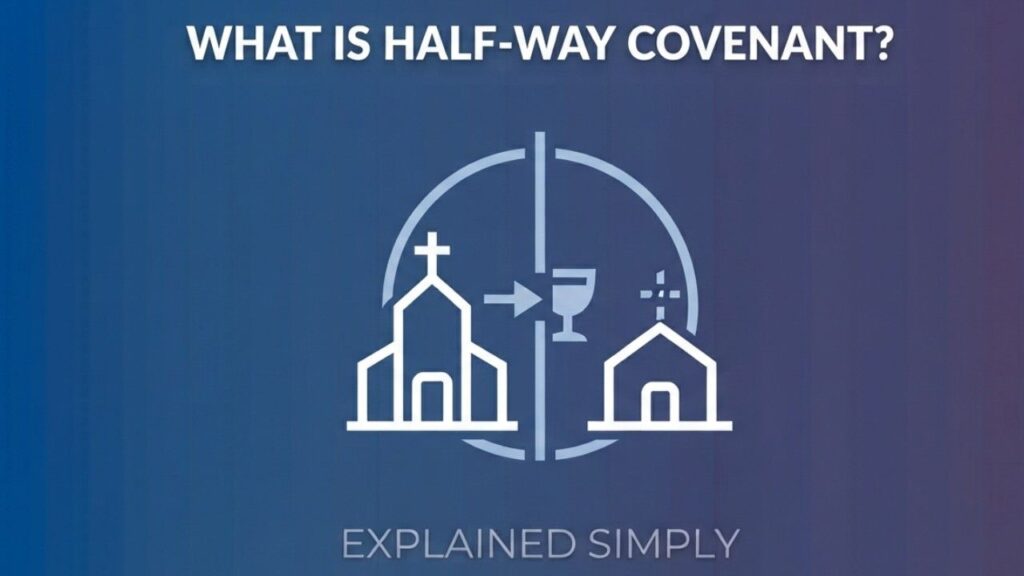
What is Half-Way Covenant – The Half-Way Covenant was a compromise within Puritan churches to expand membership and maintain religious influence in society. As fewer adults reported conversion experiences, ministers sought a way to keep their children within the church. The covenant permitted baptism and limited membership rights without requiring full conversion.
How the Half-Way Covenant Worked
- Eligibility: Children of baptized but non-converted parents could be baptized.
- Membership status: These members could participate in church life but could not take communion or vote in church affairs.
- Purpose: Designed to preserve church authority and ensure the next generation remained tied to Puritan faith.
Benefits and Uses
- Maintained church influence: Prevented decline in membership.
- Encouraged community unity: Allowed more families to remain connected to the church.
- Preserved tradition: Kept baptism as a central rite for children.
Examples
- In Massachusetts Bay Colony, ministers like Richard Mather supported the covenant to address declining conversions.
- Congregations adopted it to balance strict religious standards with practical concerns about church survival.
Also Read-What is Dry Contact Relay
Half-Way Covenant vs Full Membership
| Half-Way Covenant | Full Membership |
|---|---|
| Baptism allowed without conversion | Requires personal conversion experience |
| Limited rights (no communion, no voting) | Full rights in church governance |
| Designed for children of baptized parents | Reserved for “visible saints” |
| A compromise measure | Original Puritan ideal |
FAQs : What is Half-Way Covenant
Why was the Half-Way Covenant created?
To address declining church membership as fewer adults reported conversion experiences
Did the Half-Way Covenant weaken Puritan standards?
Critics argued it diluted strict religious requirements, while supporters saw it as necessary for survival.
Who could join under the Half-Way Covenant?
Children of baptized but non-converted parents.
Did all churches adopt it?
No, some congregations resisted, believing it compromised Puritan ideals.