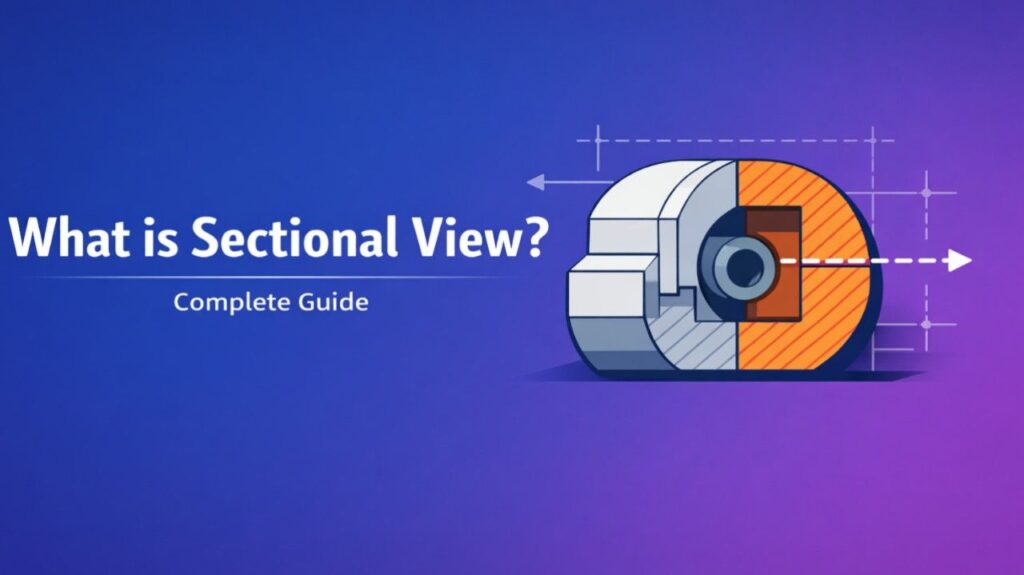
What is Sectional View – Sectional view is a drawing method where part of an object is imagined to be cut away, and the exposed interior is shown. This technique helps engineers, architects, and designers communicate complex internal structures that standard external views cannot display.
How Sectional Views Work
- Cutting plane: A line or plane slices through the object.
- Exposed interior: The cut reveals hidden parts like holes, cavities, or reinforcements.
- Hatching lines: Shaded or patterned lines indicate the cut surfaces.
Types of Sectional Views
- Full Section: The object is cut entirely along a plane.
- Half Section: Only half of the object is cut, useful for symmetrical parts.
- Offset Section: The cutting plane bends to pass through important features.
- Broken-out Section: Only a small portion is cut away to show detail.
Benefits of Sectional Views
- Clarity: Reveals hidden details that external views miss.
- Accuracy: Ensures precise communication of design intent.
- Efficiency: Helps manufacturers and builders avoid mistakes.
Also Read-What is Hapi
Example
In mechanical engineering, a sectional view of a gearbox shows the arrangement of gears, shafts, and bearings inside—information impossible to capture in a simple external drawing.
Sectional View vs Orthographic View
| Sectional View | Orthographic View |
|---|---|
| Shows interior by cutting | Shows exterior only |
| Uses hatching for cut surfaces | No hatching, just outlines |
| Reveals hidden features | Hidden features shown with dashed lines |
FAQs : What is Sectional View
Why are sectional views important?
They make complex designs understandable by exposing internal details.
Who uses sectional views?
Engineers, architects, product designers, and manufacturers.
How are sectional views drawn?
By defining a cutting plane and applying hatching to the cut surfaces.
Are sectional views used in 3D modeling?
Yes, CAD software often generates sectional views automatically.