
She Saved a Waitress—Then Heard Her Dead Husband’s Voice
The waitress had almost pulled her hand free when the man tightened his grip and smiled. “Let go of me!” Her voice cut through the diner’s late shift quiet. At…
The waitress had almost pulled her hand free when the man tightened his grip and smiled.
Thank you for reading this post, don't forget to subscribe!“Let go of me!”
Her voice cut through the diner’s late shift quiet. At the counter, a truck driver stopped stirring his coffee. The cook looked through the serving hatch. Nobody moved.
“Sit down, sweetheart.”
Mara Quinn set down her cup.
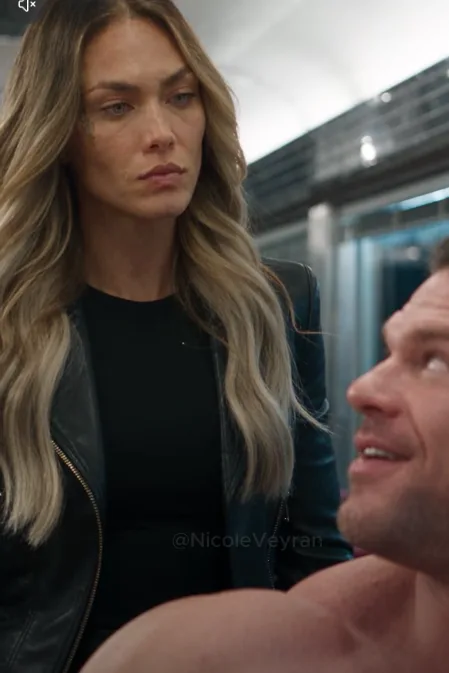
She had been sitting two tables away for twenty minutes, wearing a black leather jacket that still smelled faintly of rain. Her long blonde hair was loose around her shoulders. A plate of untouched toast lay beside a folded newspaper.
She stood, stepped clear of her chair, and walked toward them.
The man was enormous. His shirt hung over the back of a nearby booth, darkened by the coffee he had spilled on himself earlier. He wore black trousers and the satisfied expression of someone accustomed to making other people uncomfortable.
The waitress stood on the aisle side of his table, feet braced against the floor. She was trying to remain upright without letting him pull her closer.
Mara stopped beside the table.
“Take your hands off her.”
The man looked up.
For a second, something sharper than annoyance moved across his face.
Recognition.
Then it was gone.
“Mind your business.”
He released the waitress and rose.
She retreated two steps beside the neighboring red booth, holding her wrist against her apron.
Mara did not follow him. She kept her hands lowered and left him room to walk away.
He stepped toward her instead.
The first swing was wide and ugly. Mara moved out of its path, her shoes gripping the floor. She answered with one punch that drove him backward a step.
He came forward again.
Two distinct kicks followed, each separated by the return of her foot to the floor. His balance broke. He stumbled into the loose chair behind him, tipped it sideways, and struck the table edge before falling.
Dishes rattled. The table shifted several inches.
Mara stopped immediately.
The whole confrontation had lasted seconds.
She turned toward the waitress.
“You okay?”
The woman nodded, but her face had changed.
Relief was there.
So was something worse than the fear she had shown while he held her.
Mara remained between them as the man rolled onto one elbow.
He looked up at her and smiled again.
“There she is,” he said. “Same old Mara.”
Behind the counter, the waitress began to cry.
Four years earlier, Mara had been an investigator for the city’s public integrity office. She examined contracts, payroll records, and the little discrepancies powerful people dismissed as clerical mistakes.
Her husband, Lucas, maintained electrical systems at the Briar Foundry. They had rented a narrow house near the river, kept a vegetable garden badly, and talked about adopting a dog whenever their schedules became less ridiculous.
Then the foundry burned.
Lucas and six other workers died.
The official inquiry blamed an electrical fault and unauthorized maintenance. Lucas’s name appeared throughout the report, followed by phrases Mara could not read without feeling sick.
She found invoices for repairs that had never been completed. Inspection photographs had been reused. Someone had approved occupancy while serious safety complaints remained unresolved.
She reported what she found.
Two months later, evidence appeared showing that she had altered financial records in the investigation.
Her supervisor testified against her.
Her career ended. A conviction followed. So did eighteen months in prison and a newspaper photograph that made her look like a stranger even to herself.
She had been free for eleven days.
Only her attorney, Olivia Ward, had answered every call throughout the appeal. Olivia had known her before the trial, before Lucas died, before the newspapers learned to put disgraced in front of her name.
Tonight, an anonymous message had brought her to the diner.
Ten forty. Nighthawk. Come alone. I know who kept the doors locked.
She had not expected a friendly welcome.
But she had not expected Dane Kessler either.
The man on the floor had run security at the foundry.
At her trial, he claimed she had threatened him after he refused to support her accusations.
Now he was reaching slowly for the phone in his pocket.
Mara took a step back.
“Keep your hands where we can see them,” the cook called.
His voice surprised everyone, including himself.
He came through the swinging kitchen door carrying a clean towel, stopped beside the counter, and looked directly at Dane.
“I’ve called for help. Don’t make this worse.”
The truck driver stood too.
“He swung first,” he said.
Dane’s smile thinned.
Mara looked toward the waitress.
Her name tag said LENA.
She had stopped crying. Now she was staring at the security camera above the cash register.
“Does it record?” Mara asked.
Lena shook her head.
“Not anymore.”
“Since when?”
The cook looked at her.
She did not answer him.
“Since this afternoon,” she told Mara.
The diner’s refrigerator clicked on. Outside, a truck passed, washing pale light across the windows.
Mara looked back at Dane.
The invitation. The disabled camera. His recognition before she ever touched him.
He had wanted her involved.
“Lena,” she said carefully. “Did you send me a message?”
The waitress’s mouth trembled.
“Not that one.”
Dane pushed himself into a sitting position, breathing hard.
“Careful what you say.”
Lena flinched.
Mara turned enough to put herself between them again.
“You don’t get to give her instructions.”
For a moment, the woman in the white shirt looked as though she might run through the kitchen and never come back.
Then the cook spoke.
“Stay, Lena.”
It was almost a plea.
“Whatever this is, you don’t have to face it by yourself.”
She looked at him.
“I’m sorry, Frank.”
“Tell me later.”
Mara watched Dane’s phone slide from his pocket onto the floor. Its screen lit with an incoming call.
He reached for it.
“Leave it,” she said.
“It’s mine.”
“Then let whoever’s coming sort it out.”
The screen went dark.
Nobody touched it.
Lena pressed her injured wrist against her chest.
“They said you’d be angry,” she whispered.
Mara looked at her.
“Who did?”
“They said you’d lost everything and needed someone to blame. That if you came here, you’d hurt somebody.”
“Did they tell you to let him grab you?”
Lena shook her head fiercely.
“They said he’d start an argument. I was supposed to keep you talking until he got here.”
Mara felt a familiar coldness settle behind her ribs.
“Until who got here?”
Before Lena could answer, blue light moved across the chrome window frames.
A patrol car stopped outside.
Dane looked toward the entrance.
And relaxed.
Two officers entered, a young woman and an older man whose raincoat was dark across the shoulders.
The woman looked first at Dane, then at the overturned chair, then at Mara’s hands.
“Everybody stay where you are.”
Mara nodded.
“He grabbed the waitress. Then he attacked me.”
Dane laughed painfully.
“She’s been threatening me for years. Look up her name.”
The older officer glanced at his partner.
“Quinn?”
Mara felt the room begin arranging itself into the shape of her worst memory.
The young officer stepped forward.
“I’m Officer Price. We’ll speak to everyone separately.”
She asked whether anyone needed an ambulance. Dane immediately demanded one. Lena said her wrist hurt. Frank fetched a wrapped cold pack and offered it without touching her.
Mara remained still.
“You can sit over there,” Price told her, indicating the booth nearest the door. “Keep your hands visible.”
She sat.
For eighteen months, other people had told her where to put her hands.
She placed them on the table and concentrated on the feeling of cool metal beneath her palms.
Dane began describing an unprovoked attack. He omitted Lena’s wrist entirely.
The truck driver interrupted.
“That’s not what happened.”
“Sir, you’ll have your turn,” the older officer said.
“Make sure I do.”
His voice shook. Mara noticed because courage so rarely sounded the way people imagined it would.
Officer Price asked Frank about the camera.
“It’s disconnected,” he admitted.
“Why?”
He looked toward Dane.
“The building manager said they needed to inspect the wiring. Someone came this afternoon.”
“Name?”
“I didn’t ask.”
The shame in his voice was plain.
The diner leased its space from a property company connected to the old foundry owners. Mara had discovered that relationship while choosing where to sit.
Now she understood why the meeting place had seemed so carefully chosen.
The older officer helped Dane onto a chair. His phone remained on the floor until Price photographed its position and asked whose it was.
“Mine,” Dane said. “I’d like it back.”
It rang again.
Price looked down at the screen.
Mara saw the name reflected in her expression before she read it herself.
RUSK.
Lieutenant Daniel Rusk had supervised security arrangements during the foundry investigation. His account of Mara’s conduct had helped persuade the jury that her evidence could not be trusted.
Price looked at her partner.
“Is the lieutenant coming?”
“He asked to be notified about incidents involving this address.”
Mara felt her stomach tighten.
“Before tonight?”
The officer looked at her.
“You need to let us handle this.”
“Then handle what happened. Not my name.”
Price’s eyes moved toward the counter.
“Lena, can we talk in the kitchen?”
“No,” Lena said.
Everyone looked at her.
She swallowed.
“I want to say it here.”
Dane shifted in his chair.
“That wouldn’t be smart.”
Price turned sharply.
“Don’t speak to her.”
For the first time, his confidence cracked.
Lena looked at Mara across the aisle.
“I worked in the foundry office,” she said. “Part time. Before the fire.”
Mara remembered a young woman at a payroll desk, dark hair pinned back, a photograph of her father beside the monitor.
She had never known her name.
“They asked me what time Lucas left,” Lena continued. “I said I didn’t know. That wasn’t true.”
Mara’s hands pressed harder against the tabletop.
“What time?”
“He didn’t leave.”
The diner seemed to narrow around those words.
“I saw him trying to get people through the east exit. He was pulling at the door. He was shouting for somebody to open it.”
Frank covered his mouth.
Lena looked at him.
“Dad, I’m sorry.”
The cook closed his eyes.
Mara understood then why he had sounded as if he were begging her to stay.
“They told me they’d blame him,” Lena said. “He worked maintenance too. He’d complained about the locks. They had documents with his name.”
Frank slowly lowered himself onto a stool.
“You should have told me.”
“They said you’d go to prison.”
“You should have told me anyway.”
His voice broke on the last word.
Officer Price asked Lena to continue.
“I kept a copy of something. I didn’t understand all of it then. A recording Lucas sent to the office phone before the fire.”
“Where is it?” Dane demanded.
The older officer stepped between him and the counter.
“Enough.”
Lena looked frightened again, but she did not stop.
“I tried contacting Mara’s attorney last month. The old office was closed. Somebody gave me another number.”
“Who?” Mara asked.
“A man who said he was helping with your appeal. He knew your case. He knew when you were coming home.”
Mara said nothing.
“He told me to wait. Then today he said you were coming here. Dane arrived first. He told me what to say.”
“And you listened?”
The question escaped before Mara could soften it.
Lena’s face crumpled.
“Yes.”
There was no useful excuse to put after it.
Outside, another car pulled into the parking lot.
No flashing lights this time.
Dane looked toward the windows.
Mara followed his gaze.
Daniel Rusk stepped out, fastening his coat.
He had aged since the trial. His hair was almost entirely gray now, but he still walked with the assurance of a man whose version usually became the official one.
Mara felt a sudden urge to leave through the kitchen.
Then she saw Lena standing alone beside the counter.
She stayed seated.
Rusk entered, surveyed the furniture, and sighed.
“Mara.”
He said her name like a disappointment he had expected.
“Daniel.”
He turned toward Price.
“I know the history here. I’ll take over.”
Price held her notebook against her chest.
“We have several witnesses and an injured employee. I haven’t finished their accounts.”
“You can give me what you have.”
“I’ll finish the initial report.”
The older officer looked from one to the other.
Rusk’s expression cooled.
“Officer.”
Before he could continue, a voice came from the far booth.
“I have the whole thing.”
A young man in a grocery store uniform stood with his phone in his hand.
Mara had noticed him when she arrived, half asleep over a milkshake. She had forgotten him when Dane stood up.
“I started recording when he grabbed her,” he said. “My sister works nights. I didn’t like how he was talking.”
Dane went still.
Rusk turned toward him.
“Bring that here.”
The young man hesitated.
Then he looked at Officer Price.
“I’d rather give it to her.”
The silence that followed was deeper than the one after the fight.
Price took a step toward the young man.
“What’s your name?”
“Aaron.”
“Thank you, Aaron. Keep the original. We’ll arrange a proper copy.”
Rusk looked at her.
“I gave you an instruction.”
The older officer finally spoke.
“Lieutenant, your name’s come up in what the waitress is telling us. We should get another supervisor.”
Rusk’s gaze moved slowly across the diner.
The cook. The truck driver. The young man holding a phone. The woman whose wrist he had expected everyone to overlook.
For years, Mara had believed power was something held by the person with the largest office or the most convincing title.
Now she watched it falter because several frightened people refused to be quiet together.
Price viewed the recording where Aaron stood. The picture shook, but the sequence was clear. Dane caught Lena’s wrist. Mara approached. He released Lena, stood, and swung first.
There was no missing beginning to invent.
Rusk asked to speak outside.
The older officer accompanied him, keeping the diner door open behind them.
An ambulance arrived. A paramedic examined Lena’s wrist while another checked Dane. He complained loudly, then fell silent when Price asked him to stop addressing the witnesses.
Mara called Olivia.
“Don’t say anything else until I get there,” her attorney said.
“There’s a recording from the foundry.”
A brief pause.
“Do you have it?”
“Not yet.”
“Then wait. I’m coming.”
Mara ended the call with the first fragile sense that the night might not end in another locked room.
Across the aisle, Lena was watching her.
“Your lawyer?”
“Yes.”
“The one who helped you?”
“She’s still helping.”
Lena lowered her eyes.
Frank brought Mara a fresh cup of coffee. His hands shook badly enough that some spilled into the saucer.
“I should have stepped in sooner,” he said.
Mara looked toward his daughter.
“You stepped in.”
“After you did.”
He set the pot down.
“I stood here thinking about rent. About whether he’d come back tomorrow. About every stupid thing except her face.”
Mara had no comforting sentence large enough for that confession.
“Talk to her,” she said.
Frank nodded.
He went to Lena, crouched beside her chair, and said something too quietly for Mara to hear. Lena began crying again. This time, she leaned toward him.
The truck driver approached Mara’s booth.
“I’m Ed,” he said.
“Mara.”
“I know.”
She waited.
He looked embarrassed.
“I read about you. Thought I understood what happened.”
“Most people did.”
“I’m sorry.”
She turned the cup between her hands.
“Tell them what you saw tonight.”
“I will.”
It was more useful than an apology, and more difficult to ask for.
Mara looked down at her coffee. A thin circle of light moved across its surface whenever someone walked past the table.
Lucas had hated diner coffee. He drank it anyway because the place near their house stayed open after his shift, and he liked an hour in which neither of them had anywhere to go.
On their last ordinary evening together, he had brought a folded maintenance complaint and put it beneath the sugar dispenser.
“Tell me if I’m being difficult,” he had said.
She had read it twice.
He was not being difficult. Employees had been raising the same problems for months. Each response promised another meeting, another inspection, another opportunity to be patient.
Mara made copies at home. She advised him to keep his own notes and submit everything through the proper channels. She believed in channels then, in the comforting idea that a documented concern would eventually reach someone responsible.
Two days later, she mentioned the complaints to Olivia over lunch.
They had known each other for years. Olivia had helped Mara understand complicated cases when she was new to investigative work. Later, she had become the friend who remembered anniversaries and brought groceries after Lucas died.
“Let me look before you send anything further,” Olivia had said. “There may be a cleaner way to raise this.”
Mara had thanked her.
After the fire, the copied complaints became the beginning of a much larger investigation. But the originals disappeared from the foundry office, and people who had signed them began claiming they remembered things differently.
Only Olivia remained constant.
She found an expert. She challenged the prosecution. She stood beside Mara outside court while photographers shouted questions neither of them answered.
When the verdict came, Olivia held her hand.
Now, sitting in another diner beneath another sugar dispenser, Mara tried to remember whether she had ever told Lucas that she had shown his complaints to her friend.
She could not.
The uncertainty made her unexpectedly angry. Grief had taken so many ordinary details and left her with useless precision about the worst ones: the color of a courtroom wall, the smell of the bus that carried her away.
Lena’s voice brought her back.
“Do you need anything?”
The waitress stood beside the table, still cradling the cold pack.
For a moment, Mara almost asked for her husband, her job, the garden with its miserable tomatoes, all the things no stranger could carry back from a kitchen.
Instead, she shook her head.
“Just stay where people can see you.”
Lena nodded and returned to her father.
For the first time that night, neither woman had to pretend she was unafraid.
Another supervisor arrived from outside Rusk’s immediate command. Price explained what she had recorded. The conversations grew quieter. Rusk remained in the parking lot beside the older officer.
Nobody announced a grand arrest or declared Mara innocent of everything that had happened four years earlier.
But nobody put her in handcuffs either.
For tonight, that mattered.
When Lena’s wrist had been checked, she came to Mara’s table.
“I have the recording,” she said.
“Where?”
“Somewhere Dane can’t take it from me.”
She looked toward Officer Price.
“I want it documented. Before I lose my nerve.”
Mara stood with her.
The recording had survived in an old account associated with the foundry’s office voicemail. Lena had saved an original copy after the fire, then spent four years unable to decide what courage should look like.
Tonight, it looked like asking a young officer to listen.
She produced the saved file on her phone. Price arranged for its preservation, noting Lena’s explanation of where it came from and how she had kept it.
“I know this doesn’t make what I did disappear,” Lena told Mara.
“No.”
The answer hurt them both.
“I thought if I stayed quiet, Dad would be safe. Then I watched you go to prison.”
Mara looked through the windows at the wet parking lot.
For eighteen months, she had imagined confronting the people who had failed her. She had prepared speeches in the dark, sentences sharpened until she could almost cut herself on them.
Lena stood beside her, frightened and ordinary, with a cold pack slipping against her apron.
None of the speeches fit.
“Tell the whole truth now,” Mara said. “Even the parts that make you look bad.”
Lena nodded.
Frank pulled a chair beside her.
“I’m staying,” he said.
Price asked whether Mara wanted to hear the file before her attorney arrived.
Mara almost said no.
Then Lena whispered, “It’s his voice.”
She sat down.
For four years, Lucas had existed in fragments. A birthday video. A voicemail about milk. A laugh captured while he tried to rescue their terrible tomato plants from a storm.
She had played those recordings so often that she knew every breath before it came.
Now she was being offered words she had never heard.
Price placed the phone on the table after confirming Lena’s permission.
The file began with a click, a distant mechanical hum, and uneven breathing.
Then Lucas spoke.
“Lena, if you’re still in the office, get Frank. The east exit won’t open. We’ve got people trying to come through.”
Mara’s hand closed around the edge of the booth.
“Don’t come into the building. Find someone outside who can help.”
His voice moved away from the telephone.
Another man spoke in the background.
“Leave it alone, Lucas.”
Price looked up.
Mara knew that voice.
Daniel Rusk had testified that he arrived after the fire was already beyond control. He had described the scene from outside, with the calm certainty of an experienced officer.
On the recording, he sounded close enough to touch Lucas’s shoulder.
“There are people behind that door,” Lucas said.
A burst of noise obscured the answer.
Then his voice returned.
“You said everyone would be out.”
Mara pressed a hand against her mouth.
Price paused the recording.
“We can stop.”
Mara shook her head.
“Keep going.”
The next seconds were difficult to understand. Footsteps. Someone shouting a name. A sound that might have been a chair scraping across concrete.
There was no explanation neat enough to contain it. No single sentence that answered who started the fire, or what Lucas knew, or why the promised safety of seven workers had become something people bargained over.
But he had tried to get them out.
He had stayed.
For four years, strangers had called him careless. Mara had fought so hard against their accusations that she had almost forgotten the man underneath them: the one who checked the neighbor’s porch light, who carried groceries for people too proud to ask, who always went back.
She bowed her head.
Frank placed a clean napkin beside her without speaking.
Outside, Rusk turned toward the window.
He could see them listening.
Mara looked up and met his eyes.
This time, she did not look away.
Price made a note, then signaled the other supervisor through the glass.
Rusk began talking. His gestures were small at first, then sharper.
Mara could not hear him.
For once, his version was happening somewhere she did not have to listen.
The recording continued.
A faint female voice emerged beneath the noise.
Lena leaned forward.
“That’s the part I couldn’t identify.”
The woman spoke again, too softly for the words to be clear.
Mara felt something inside her go still.
Not because she understood the sentence.
Because she recognized the rhythm.
She had heard that voice across prison telephones. Across conference tables. Telling her to be patient when the appeal stalled, telling her that certain witnesses could not be found.
Headlights crossed the diner windows.
A dark sedan stopped beside the patrol cars.
Olivia Ward climbed out, carrying the leather document case Mara had watched her carry into court.
On the recording, Lucas spoke again.
“Olivia? What are you doing here?”
Mara stopped breathing.
The answer came through the little speaker, thin but unmistakable.
“Your wife has copies, Lucas. We need to know where.”
The diner door opened.
Olivia stepped inside and found Mara at once.
“Thank God,” she said. “I was worried.”
Chapters
Chapters will be available soon.